
Milk Thistle and Liver-Metabolized Drugs: What You Need to Know About Enzyme Interactions
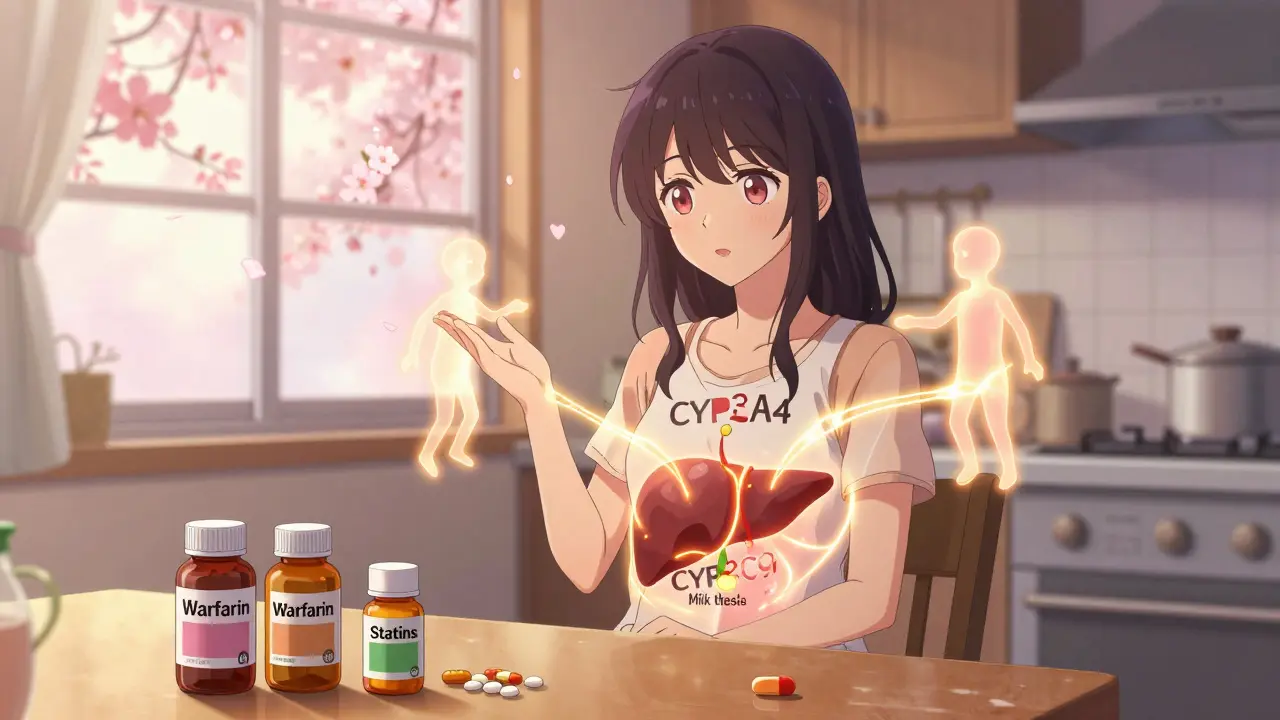
When you take milk thistle for your liver, you might think you’re just giving your body a gentle boost. But if you’re also on prescription meds-especially ones processed by your liver-what you’re really doing could be more complicated than you realize. Milk thistle doesn’t just sit there quietly. It talks to your liver enzymes. And that conversation can change how your medications work.
What Milk Thistle Actually Does in Your Body
Milk thistle isn’t some new fad. People have used it for over 2,000 years to support liver health. Today, the active part of the herb is called silymarin, a mix of compounds like silybin, silychristin, and silydianin. Most supplements contain 70-80% silymarin, with common doses ranging from 140 mg to 420 mg a day. That’s what most clinical studies have tested.
It’s not just a detox pill. Research shows silymarin helps protect liver cells, reduces inflammation, and may even help repair damage from things like fatty liver disease. In fact, over 65% of studies on non-alcoholic fatty liver disease (NAFLD) found improvements in liver enzyme levels after using milk thistle. That’s why so many people take it-especially those with long-term liver concerns.
But here’s the catch: your liver doesn’t just handle toxins. It’s also the main factory that breaks down most prescription drugs. And silymarin interferes with that process-sometimes in ways that are hard to predict.
How Milk Thistle Interacts With Liver Enzymes
Your liver uses a family of enzymes called cytochrome P450 (CYP) to break down drugs. The big players here are CYP3A4, CYP2C9, and CYP2D6. These enzymes handle about 80% of all medications you take-from blood thinners to antidepressants to statins.
Studies on milk thistle’s effect on these enzymes give mixed results. Some show it blocks them. Others show it speeds them up. And some show no effect at all.
For example, a 2021 lab study found silymarin reduces CYP2C9 activity by 15-23%. That’s a big deal because CYP2C9 breaks down warfarin, phenytoin, and some diabetes drugs. If this enzyme slows down, those drugs stick around longer in your blood. That can lead to bleeding risks with warfarin or toxicity with phenytoin.
But then a 2019 clinical trial gave 420 mg of silymarin daily to 24 healthy people for two weeks. They checked how the body handled midazolam-a drug processed by CYP3A4. Result? Only a 7.2% increase in drug levels. That’s way below the 20% threshold doctors consider clinically meaningful.
Even weirder? The effect changes over time. A 2020 study found that after just a few days, silymarin blocked CYP2C9. But after 28 days, it started increasing enzyme activity. So the same supplement can have opposite effects depending on how long you’ve been taking it.
And that’s not even the whole story. Your body absorbs only 20-50% of silybin-the most active part of milk thistle. That means two people taking the same dose might get completely different amounts into their bloodstream. Add in genetic differences in liver enzymes, and you’ve got a recipe for unpredictable results.
Real-World Cases: When It Goes Wrong
Lab studies are one thing. Real people are another.
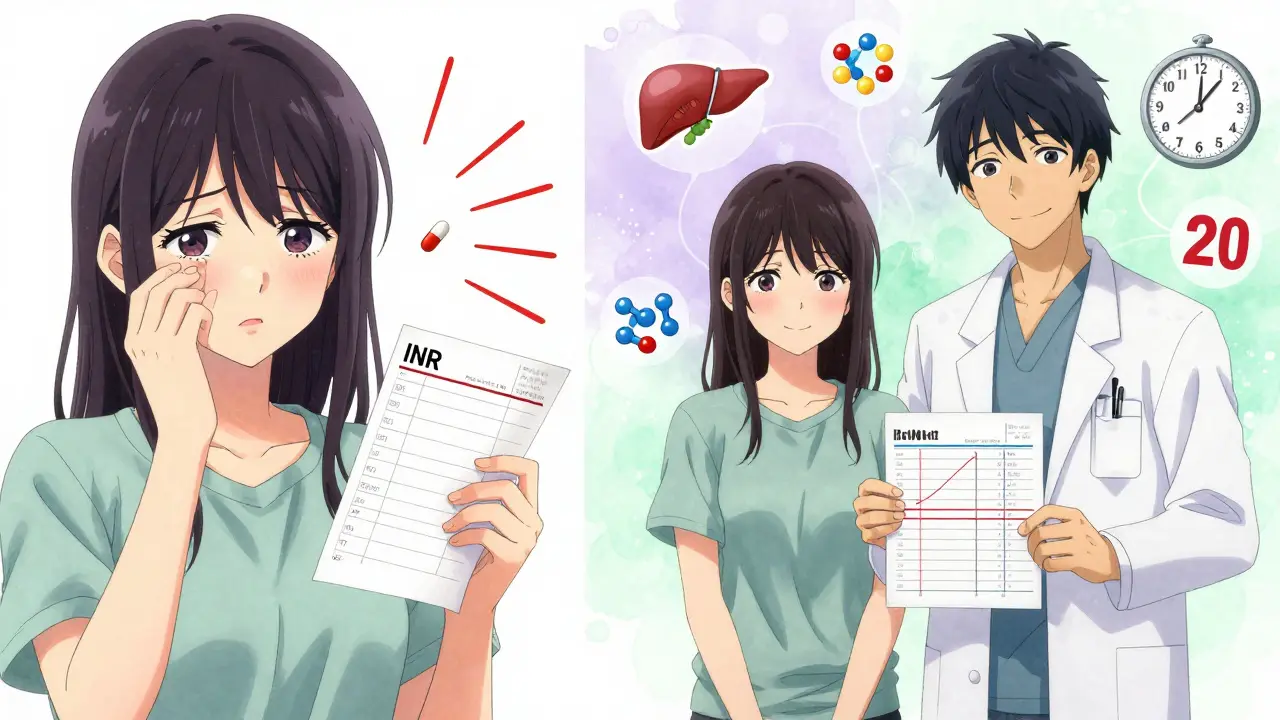
On Reddit’s r/Supplements, a thread from February 2024 has 87 comments from people who started milk thistle and saw their INR levels-how well their blood clots-go haywire. Forty-three people reported changes. Twenty-eight needed to adjust their warfarin dose by 15-35%. That’s not a coincidence. That’s a warning.
The FDA’s adverse event database has 47 reports of possible milk thistle-drug interactions between 2018 and 2023. Only nine were confirmed as actual interactions. But even one confirmed case is too many when you’re talking about blood thinners.
One 58-year-old man with hepatitis C took 420 mg of milk thistle daily while on sofosbuvir/velpatasvir (a direct-acting antiviral). He reported no issues. That’s good news. But that’s not the whole picture. Most people don’t report side effects unless something bad happens. And many don’t even know to connect their new supplement to their changed medication effects.
Meanwhile, Amazon reviews for top-selling milk thistle products show only 2.1% mention drug interactions. Most people report feeling better. That’s why doctors hear so little about it-until someone ends up in the ER with a dangerously high INR.
How It Compares to Other Liver Supplements
Not all liver supplements act the same.
N-acetylcysteine (NAC) helps your liver make glutathione, a powerful antioxidant. It’s great for acetaminophen overdose and supports detox-but it doesn’t mess with liver enzymes. That makes it safer if you’re on multiple meds.
Artichoke extract also affects CYP2C9, but it does so consistently-always inhibiting it by about 15-20%. Milk thistle? It’s all over the place. Sometimes inhibits. Sometimes induces. Sometimes does nothing.
Compared to prescription liver drugs like ursodeoxycholic acid, milk thistle has a much better safety record. Only 1.2% of people in clinical trials reported side effects. That’s way lower than the 8.7% seen with pharmaceuticals. But that doesn’t mean it’s risk-free. The problem isn’t toxicity-it’s unpredictability.
What Doctors Actually Say
There’s no consensus. That’s the problem.
Dr. Joseph Pizzorno, a leading voice in natural medicine, says the risk is overblown. He points to only 12 case reports in 40 years of widespread use-and none proved milk thistle caused the issue. He believes most reports are coincidence, not causation.
But Dr. David S. Bernstein, a hepatologist at the University of Connecticut, says otherwise. He warns that without standardized extracts and consistent data, doctors should be cautious-especially with patients on narrow therapeutic index drugs like warfarin, cyclosporine, or certain seizure medications.
The European Medicines Agency says no clinically relevant interactions are expected at standard doses. The U.S. NIH’s LiverTox database says milk thistle is “possibly interacting” with CYP2C9 substrates and “likely safe” with most others. That’s not a clear green light. It’s a yellow caution sign.
What You Should Do If You’re Taking Milk Thistle
If you’re on any prescription drug, especially one of these, talk to your doctor or pharmacist before starting milk thistle:
- Warfarin (Coumadin)
- Phenytoin (Dilantin)
- Statins (atorvastatin, simvastatin)
- Immunosuppressants (cyclosporine, tacrolimus)
- Some antidepressants and antifungals
Here’s what to do:
- Check your current meds. Look up whether they’re metabolized by CYP2C9, CYP3A4, or CYP2D6. Many drug labels list this.
- If you’re on a drug with a narrow therapeutic index (where small changes can cause harm), don’t start milk thistle without supervision.
- If you already take it, get your blood levels checked. For warfarin, check INR weekly for the first month after starting. For phenytoin, check levels at days 3, 7, and 14.
- Don’t switch brands. Supplement quality varies wildly. Only 32% of milk thistle products on the market meet their label claims. A different brand could mean a different dose-and a different interaction risk.
- Give it time. If you’ve been taking milk thistle for more than a week, your body might have switched from inhibition to induction. That means your drug levels could change again-even if you’ve been fine so far.

The Bigger Picture: Why This Matters
More than 27% of U.S. adults with liver conditions take milk thistle. That’s over 10 million people. And yet, most primary care doctors don’t feel confident advising on it. A 2023 survey found only 28% of physicians felt prepared to talk about milk thistle-drug interactions-even though 64% of patients ask about it.
The problem isn’t just the supplement. It’s the system. Milk thistle is sold as a dietary supplement in the U.S., not a drug. That means it doesn’t need FDA approval for safety or interaction labeling. Companies don’t have to test it with other meds. They don’t have to warn you.
That’s why the burden falls on you. You need to know your meds. You need to know your supplements. And you need to tell your doctor about both.
Future research is promising. Scientists are testing new forms of silybin bound to phosphatidylcholine-designed to improve absorption and reduce enzyme interactions. These might be safer in the next few years. But for now, the old version is what’s on the shelf.
Don’t assume natural means safe. Don’t assume no side effects means no interactions. Milk thistle helps the liver-but it also talks to your meds. And that conversation can change your health in ways you don’t expect.
When to Avoid Milk Thistle Altogether
Some people should skip it entirely:
- If you’re on warfarin and your INR is unstable
- If you’ve had a liver transplant and take cyclosporine or tacrolimus
- If you’re on phenytoin or other narrow therapeutic index drugs without regular monitoring
- If you’re pregnant or breastfeeding (there’s not enough safety data)
- If you’re allergic to plants in the Asteraceae family (ragweed, marigolds, daisies)
If you’re unsure, stop it. Wait. Talk to your doctor. Get your drug levels tested. It’s not worth the risk.
Can milk thistle help with fatty liver disease?
Yes, multiple studies show milk thistle can improve liver enzyme levels in people with non-alcoholic fatty liver disease (NAFLD). About 65% of clinical trials found reductions in ALT and AST, two key markers of liver inflammation. It’s not a cure, but it’s one of the few supplements with consistent evidence for supporting liver health in this condition.
Does milk thistle interact with statins?
It might. Statins like atorvastatin and simvastatin are broken down by CYP3A4. While most studies show no major interaction, some case reports suggest milk thistle could raise statin levels slightly, increasing the risk of muscle pain or damage. If you’re taking statins and start milk thistle, watch for unexplained muscle soreness or weakness. Get your CK levels checked if symptoms appear.
How long does it take for milk thistle to affect liver enzymes?
Effects on liver enzymes like ALT and AST usually show up after 4-8 weeks of daily use. But effects on drug-metabolizing enzymes happen faster. Inhibition can occur within 24-48 hours. Induction takes longer-usually 7-10 days. That’s why timing matters. If you’re on a critical drug, monitor closely during the first two weeks.
Is milk thistle safe with alcohol?
Milk thistle is often taken to protect the liver from alcohol damage. While it may help reduce oxidative stress, it doesn’t make heavy drinking safe. It also doesn’t reverse cirrhosis. If you drink alcohol regularly, talk to your doctor before using milk thistle. It’s not a license to drink more.
What’s the best form of milk thistle to take?
Look for standardized extracts with 70-80% silymarin. Silybin-phosphatidylcholine complexes (like Siliphos) have better absorption and may be less likely to interfere with liver enzymes. Avoid whole-herb powders-they’re inconsistent and poorly absorbed. Always choose brands that provide third-party testing (USP, NSF, or ConsumerLab verified).
Can I take milk thistle with my other supplements?
Most other supplements like vitamin D, magnesium, or omega-3s don’t interact with milk thistle. But avoid combining it with other liver-affecting herbs like kava, comfrey, or green tea extract in high doses-they can increase liver stress. Stick to one liver support at a time unless your doctor approves otherwise.
Final Thought: Know Your Meds, Know Your Supplements
Milk thistle isn’t dangerous. But it’s not harmless either. It’s a powerful plant compound that talks to your liver’s drug-processing system. And if you’re on medications that need precise dosing, that conversation matters.
You don’t need to avoid it. But you do need to be smart. Check your meds. Talk to your doctor. Get tested if needed. Don’t assume natural means safe. And don’t let a supplement you bought online replace a conversation with your healthcare provider.

Jay Powers
January 13, 2026 AT 08:16Man I just started milk thistle last week for my fatty liver and now I’m reading this and my stomach is in knots
Rinky Tandon
January 15, 2026 AT 00:30So you’re telling me my $20 bottle of ‘liver detox’ from GNC could be messing with my blood thinner and I didn’t even know it? That’s wild. I’m done with supplements. I’m going back to whiskey. At least I know what that does.
Sumit Sharma
January 16, 2026 AT 23:06Let’s be clear: silymarin’s biphasic modulation of CYP2C9 is well-documented in pharmacokinetic literature. The 2020 longitudinal study by Kim et al. demonstrated time-dependent enzyme induction following initial competitive inhibition. This isn’t anecdotal-it’s mechanistic. Patients on warfarin with INR fluctuations should be monitored at day 3, day 7, and day 28. Ignoring this is negligence, not ‘natural living’.
Alex Fortwengler
January 18, 2026 AT 09:10Big Pharma doesn’t want you to know this because they can’t patent a plant. They’ve been suppressing studies for decades. That 47-report FDA database? They only count the ones they can blame on you. The real number is 10x higher. And they’re gonna make you pay for it with your kidneys next.
Cassie Widders
January 18, 2026 AT 13:20I’ve been taking it for 3 years with my statin and never had an issue. Maybe it’s just not for everyone?
Monica Puglia
January 19, 2026 AT 03:52Y’all are overthinking this 😅 I just take mine with breakfast and check my INR once a month. If my blood’s not clotting like a brick, I’m good. 🌿🩸
jordan shiyangeni
January 21, 2026 AT 03:10People treat supplements like candy because they’ve been conditioned by capitalism to believe that anything ‘natural’ is inherently virtuous. But the liver doesn’t care if it’s from a tree or a lab-it only cares about molecular structure and enzyme affinity. You’re not ‘detoxing’-you’re chemically modulating a vital metabolic pathway. And if you don’t understand that, you’re not just ignorant-you’re endangering your life. And you wonder why the system is broken.
Craig Wright
January 21, 2026 AT 10:05In Britain, we have the MHRA. They regulate these things properly. Here in America, you can buy a substance with unknown pharmacokinetics off Amazon and call it ‘wellness’. It’s a disgrace. If you’re on warfarin, you should be legally required to consult a pharmacist before taking any herbal extract. This isn’t freedom-it’s recklessness.
Eileen Reilly
January 21, 2026 AT 18:49so like… i took milk thistle for 2 weeks and my liver enzymes went down but then my knee started aching? is that the statin? or the milk thistle? or am i just old?? 🤷♀️
Sumit Sharma
January 23, 2026 AT 13:23Monica Puglia’s comment is dangerously reductive. INR fluctuation isn’t a ‘check once a month’ issue-it’s a dynamic pharmacodynamic response. Silymarin’s inhibition window peaks at 48-72 hours post-ingestion. If you’re on warfarin, you need daily INR checks for the first 14 days, not ‘if my blood’s not clotting like a brick’. That’s not wellness, that’s Russian roulette with anticoagulation.
steve ker
January 24, 2026 AT 19:24Why are we even talking about this? Everyone knows supplements are placebo. Just take your meds and stop wasting money
Ben Kono
January 26, 2026 AT 05:28My cousin took milk thistle with his HIV meds and his viral load dropped like crazy. He says it’s the secret cure. I don’t know but he looks way better than before
Cecelia Alta
January 26, 2026 AT 07:11Okay but what if you’re the person who’s been taking milk thistle for 5 years and your doctor never asked? What if you’re the one who had a stroke because your INR spiked and no one told you to get tested? Who’s responsible then? The supplement company? The doctor? The FDA? Or just… you? Because you didn’t read the fine print on a bottle labeled ‘100% natural’? This isn’t about science-it’s about who gets to die quietly while the system keeps selling you hope.
Abner San Diego
January 26, 2026 AT 18:13Look, I’m not some herbalist. I’m just a guy who works in IT. But I took milk thistle because my liver enzymes were high after drinking too much during lockdown. They went back to normal. I didn’t touch my statin. I didn’t feel anything different. So why are we acting like this is some deadly conspiracy? Maybe the real problem is that doctors don’t know enough about supplements-and instead of learning, they just panic. I’m not saying it’s perfect. But maybe it’s not the villain we’re making it out to be.