
Insurer Pressure: How Providers Respond to Generic Drug Substitution Requirements
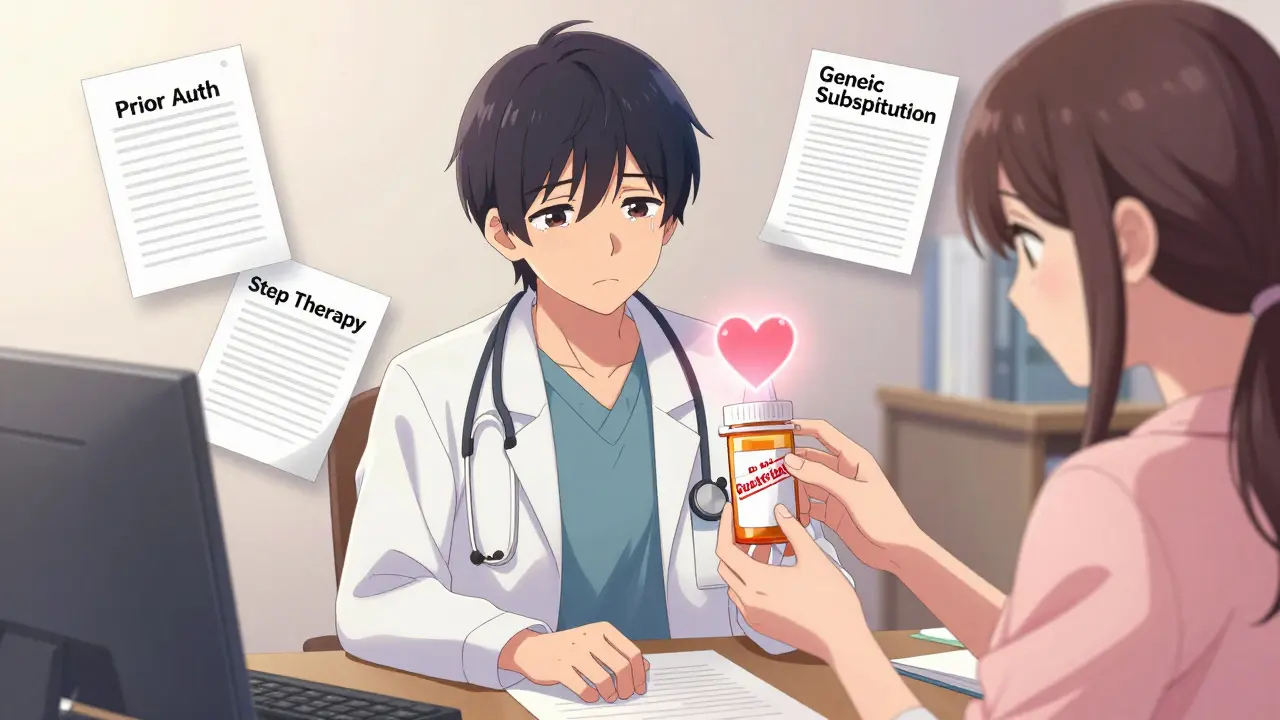
When your doctor writes a prescription for a brand-name medication, and the pharmacy tells you it’s not covered unless you switch to a cheaper generic version, you’re seeing the direct result of insurer pressure. It’s not just about cost-cutting-it’s a system designed to push providers and patients toward generics, often with little regard for individual needs. Providers aren’t just passive observers in this process. They’re caught in the middle, forced to navigate confusing rules, endless paperwork, and sometimes, real harm to their patients.
How Insurers Enforce Generic Substitution
Health insurers don’t just ask providers to use generics-they make it mandatory. This happens through three main tools: tiered formularies, prior authorization, and step therapy. Tiered formularies are the most common. Most insurance plans divide drugs into tiers based on cost. Generic drugs sit in Tier 1, with copays as low as $5. Brand-name drugs? They’re often in Tier 3 or 4, with copays of $40 to $100 or more. Patients quickly learn that sticking with the brand means paying out of pocket-sometimes hundreds of dollars extra per month. So, they switch. And providers? They’re expected to go along with it. Prior authorization is the next layer. Even if a drug is on the formulary, insurers can still block it. To get approval, providers must submit detailed clinical justification-sometimes within 72 hours. Electronic prior authorization (ePA) systems have made this faster, but not easier. These systems integrate with electronic health records, but they’re inconsistent. One insurer might require a lab result showing treatment failure. Another might demand a letter from a specialist. A 2023 MGMA survey found that 89% of physicians had to learn different rules for each major insurer. Step therapy adds another hurdle. Patients must first try-and fail-on the generic before they can get the brand-name drug. This sounds logical: if it works, why pay more? But for some conditions, failure isn’t just inconvenient-it’s dangerous. Take levothyroxine, used for thyroid disorders. Even small changes in dosage can cause serious side effects. The American Medical Association reports that 28% of physicians have seen adverse outcomes after switching patients to a different generic version.Provider Reactions: The Real Cost of Compliance
Providers aren’t just complying-they’re adapting. And it’s costing them time, money, and mental energy. A 2023 MGMA survey found that physicians spend an average of 16.9 minutes per prior authorization request. That’s nearly 17 hours a week for a single doctor. Multiply that across a practice, and you’re looking at full-time staff dedicated just to paperwork. Medium-sized practices now hire 1.8 full-time employees to handle prior authorization alone-costing over $112,000 per year per position. Some providers have developed workarounds. Sixty-eight percent now use standardized template letters for common exceptions. Others build relationships with specific case managers at insurers. A few have even started including “medical necessity” notes on every brand-name prescription, just to avoid delays. One cardiologist on Reddit said this increased his prescription processing time by 40%. But not all adaptations are successful. A Mayo Clinic physician in Minnesota described a case where a patient with a history of gastrointestinal bleeding was denied coverage for a brand-name anticoagulant. The insurer insisted on switching to the generic. The provider appealed three times over 22 days. During that time, the patient had two emergency room visits. That’s not just administrative delay-that’s preventable harm.
State Laws Are Changing the Game
Not all states let insurers run unchecked. Some are stepping in to protect providers and patients. California’s AB 347, effective January 2024, requires insurers to approve step therapy exceptions within 72 hours if clinical documentation is provided. The result? A California psychiatrist reported approval rates jumped to 92% on first submission. Before, it took two weeks. Now, it’s under three days. Arizona’s HB 2175, signed in May 2025, goes further. It bans insurers from relying solely on AI systems to deny coverage based on medical necessity. Medical directors must personally review each denial. Implementation is required by June 30, 2026. This is a direct response to cases where automated systems rejected life-saving drugs because they didn’t match rigid algorithmic criteria. These laws aren’t outliers-they’re signals. In 2024 and 2025, 34 states introduced bills to regulate prior authorization. The federal Improving Seniors’ Timely Access to Care Act already requires Medicare Advantage plans to respond to urgent prior authorization requests within 72 hours. And by January 2027, all Medicare Advantage and Medicaid managed care plans must use standardized electronic systems under the CMS Interoperability and PA final rule.Who’s Winning? Who’s Losing?
Insurers say they’re saving money-and they’re right. Generic drugs cost 80-85% less than brand-name versions. In 2022, 90% of all prescriptions in the U.S. were filled with generics. That’s up from 76% in 2010. The savings are real: over $300 billion annually, according to the FDA. But the winners aren’t always patients or providers. Pharmacy Benefit Managers (PBMs) like CVS Caremark, Express Scripts, and OptumRx control formulary decisions for 85% of insured Americans. These companies are often owned by the same insurers they serve, creating a vertically integrated system that maximizes generic use-even when it’s not clinically ideal. Pharmaceutical companies aren’t sitting still. After Lipitor went generic in 2010, Sun Life reported a 138% spike in “no substitution” claims, thanks to manufacturer coupons. These coupons let patients pay $10 for a brand-name drug, undercutting the insurer’s financial incentive. That’s why some insurers now restrict coupon use or require prior authorization even when a coupon is presented. Meanwhile, providers are bearing the burden. A 2023 AMA survey found that 29% of physicians have seen prior authorization lead to a serious adverse event-sometimes even death. Patients abandon prescriptions because the process is too complicated. Others switch to cheaper drugs and suffer side effects they weren’t warned about.
What Providers Can Do Now
You can’t stop insurer pressure. But you can manage it better.- Know your insurer’s rules. Each one has different criteria. Keep a cheat sheet for UnitedHealthcare, Cigna, Aetna, etc.
- Use ePA tools. If your EHR has integrated prior authorization, use it. A 2024 JAMIA study found it cuts approval time by 55%.
- Document everything. Lab results, prior treatment failures, side effect history-include them. The AMA says appeals with objective data have 37% higher approval rates.
- Know your state laws. If you’re in California, Arizona, or another state with reform laws, use them. They’re your leverage.
- Advocate. Join your state medical association. Push for legislation that limits step therapy and bans AI-only denials.
The Future: More Automation, More Backlash?
Insurers are doubling down. UnitedHealthcare aims for 95% generic utilization by 2030. PBMs are rolling out AI tools to auto-approve or deny requests before a provider even submits them. But the backlash is growing. The FDA is reviewing how it defines bioequivalence for narrow therapeutic index drugs. Draft guidance expected in Q3 2025 could mean stricter rules for substitutions of drugs like warfarin, lithium, and levothyroxine. Providers are tired of being the middleman between cost control and patient safety. And patients? They’re starting to notice. More are asking: “Why can’t I just take the drug my doctor prescribed?” The system isn’t broken-it was built this way. But as more states pass laws, as more providers speak up, and as more patients demand choice, the pressure won’t just be on providers anymore. It’ll be on insurers to prove that their rules don’t just save money-they protect lives too.Why do insurers force patients to switch to generics?
Insurers mandate generic substitution to reduce drug spending. Generic drugs cost 80-85% less than brand-name versions, saving the healthcare system over $300 billion annually. By steering patients toward cheaper options, insurers lower their overall costs-especially for chronic conditions like high blood pressure or diabetes, where generics are widely available.
Can a provider refuse to prescribe a generic drug?
Yes-but only if they write “Dispense as Written” or “Do Not Substitute” on the prescription. Even then, insurers may still deny coverage unless the provider submits a prior authorization request with clinical justification. Some states require insurers to honor these requests, but not all do.
Are generic drugs really the same as brand-name drugs?
By FDA standards, generics must be bioequivalent-meaning they deliver the same amount of active ingredient within a range of 80-125% of the brand-name drug. For most medications, this works fine. But for drugs with a narrow therapeutic index-like levothyroxine, warfarin, or epilepsy meds-small differences can cause serious side effects or treatment failure. That’s why many providers push back on forced switches.
What’s the difference between prior authorization and step therapy?
Prior authorization requires providers to get approval before prescribing a drug, usually by proving medical necessity. Step therapy forces patients to try and fail on a cheaper drug first before getting access to a more expensive one. Both are tools insurers use to control costs, but step therapy adds a layer of trial-and-error that can delay care.
How are states changing insurer rules?
States like California and Arizona are passing laws to limit insurer power. California requires fast approval (72 hours) for step therapy exceptions. Arizona bans insurers from using AI alone to deny coverage. Other states are capping the number of prior authorization requests, requiring written denials, and mandating medical director reviews. These changes are forcing insurers to be more transparent and accountable.
Do generic substitution policies affect patient adherence?
Yes. A 2023 MGMA survey found that 78% of physicians say prior authorization and forced substitutions sometimes lead patients to abandon their prescriptions entirely. When patients face high out-of-pocket costs, long delays, or unexpected side effects from a new generic, they stop taking the medication. That leads to worse outcomes-and higher long-term costs from ER visits and hospitalizations.
What role do Pharmacy Benefit Managers (PBMs) play?
PBMs like CVS Caremark and OptumRx control which drugs are covered and at what cost. They negotiate rebates with drugmakers and set formularies. Because many PBMs are owned by the same companies as insurers (e.g., Cigna owns Express Scripts), they have a financial incentive to push generics-even when clinical guidelines suggest otherwise.

Tola Adedipe
February 8, 2026 AT 15:23Joey Gianvincenzi
February 9, 2026 AT 23:53Amit Jain
February 11, 2026 AT 07:47Sarah B
February 11, 2026 AT 22:38Eric Knobelspiesse
February 12, 2026 AT 22:24Heather Burrows
February 14, 2026 AT 00:43Ritu Singh
February 14, 2026 AT 13:41Mark Harris
February 14, 2026 AT 23:17Savannah Edwards
February 15, 2026 AT 11:22Mayank Dobhal
February 16, 2026 AT 02:42Gouris Patnaik
February 17, 2026 AT 00:27Ariel Edmisten
February 17, 2026 AT 06:01Niel Amstrong Stein
February 18, 2026 AT 22:11