
How Generic Substitution Laws Work: State-by-State Breakdown
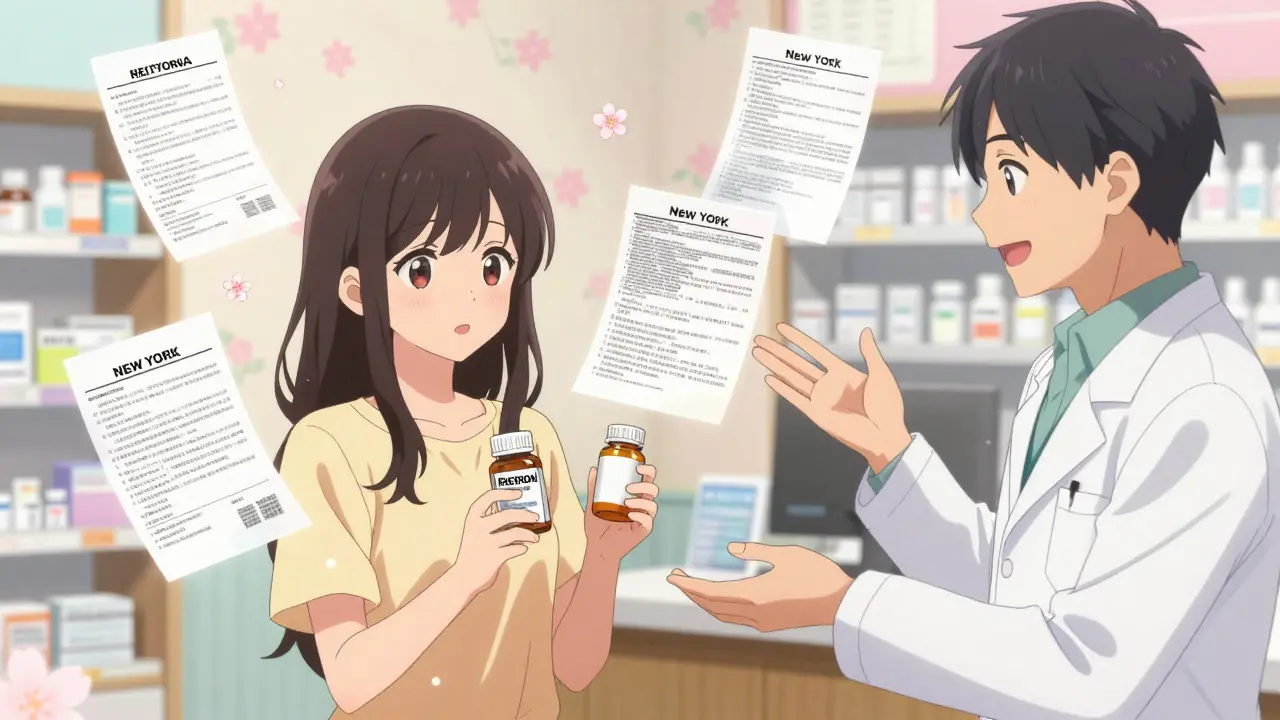
When you pick up a prescription, you might not notice the difference between the brand-name pill and the generic version sitting in your bag. But behind that switch is a complex web of state laws that control whether, when, and how a pharmacist can swap one for the other. These aren’t federal rules - they’re different in every state, and the details matter a lot. One state might require you to give permission before a substitution happens. Another might let the pharmacist make the change without telling you at all. And in some places, certain drugs - like epilepsy meds or blood thinners - are off-limits for substitution no matter what.
Why These Laws Exist
Generic drugs are chemically identical to their brand-name counterparts, but they cost far less. The FDA says they work the same way, have the same risks and benefits, and are held to the same manufacturing standards. That’s why generic drugs make up over 90% of all prescriptions filled in the U.S. But even though the science is clear, the law isn’t. States created substitution laws in the 1980s to help lower drug costs. The idea was simple: if a generic version is available and approved by the FDA, let the pharmacist swap it in unless the doctor says otherwise.But over time, things got messy. Some states wanted to protect patients from potential risks. Others wanted to cut costs as fast as possible. The result? 51 different rulebooks - one for each state and Washington, D.C. - that pharmacists have to juggle daily.
Who Gets to Decide: Mandatory vs. Permissive Laws
The biggest split in state laws is between mandatory and permissive substitution.In 19 states - including California, New York, and Texas - pharmacists must substitute a generic if it’s available and the prescription doesn’t say "dispense as written." They don’t get to choose. The law forces them to make the switch unless the doctor or patient blocks it.
In the other 31 states and D.C., substitution is optional. Pharmacists can swap the drug if they want to, but they don’t have to. Some do it every time. Others only do it if the patient asks. This creates confusion, especially for people who live near state borders or use pharmacy chains that operate in multiple states.
Here’s a quick look at how the states break down:
| Category | Number of States + DC | Examples |
|---|---|---|
| Mandatory Substitution (pharmacist must substitute) | 19 | California, New York, Texas, Florida, Illinois |
| Permissive Substitution (pharmacist may substitute) | 31 + DC | Arizona, Ohio, Pennsylvania, Maine, Washington, D.C. |
Do You Need to Give Permission?
Even in states where substitution is allowed, whether you need to give consent varies wildly.Seven states - Connecticut, Hawaii, Maine, Maryland, New Hampshire, Vermont, and West Virginia - plus Washington, D.C., require explicit consent before a pharmacist can swap your brand-name drug for a generic. That means you have to say "yes" out loud, sign a form, or confirm it electronically. The pharmacist can’t assume you’re okay with it.
In contrast, 31 states and D.C. only require notification. That means the pharmacist can swap the drug and then tell you after the fact - maybe on the receipt, maybe in a quick verbal note. You don’t have to agree ahead of time. You just need to know it happened.
Some states go further. Hawaii doesn’t just require consent - it bans substitution of antiepileptic drugs unless both the doctor and patient agree. Kentucky keeps a list of narrow therapeutic index drugs - like warfarin and levothyroxine - that can’t be swapped at all. In Oklahoma, the pharmacist can’t substitute unless either the prescriber or the patient gives permission.
What About Biosimilars? The New Frontier
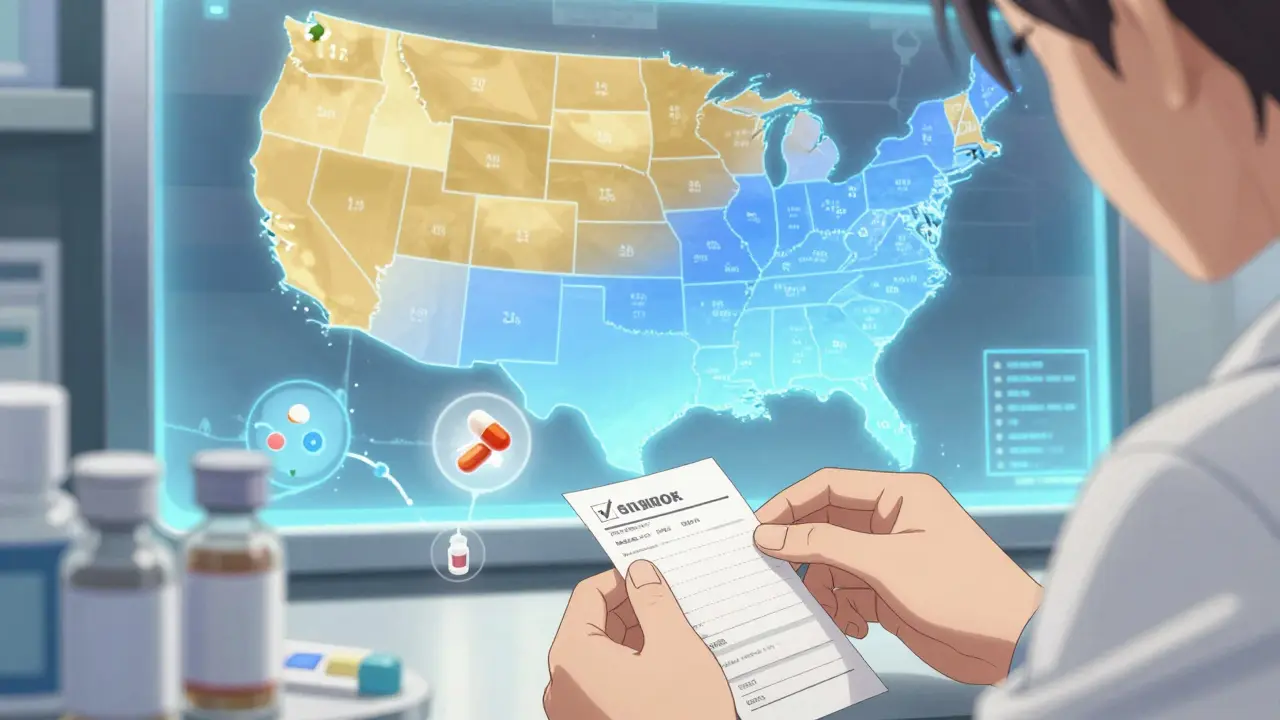
Biosimilars are the generic version of biologic drugs - complex medications used for conditions like rheumatoid arthritis, Crohn’s disease, and cancer. Unlike small-molecule generics, biosimilars aren’t exact copies. They’re highly similar, but tiny differences can matter.Because of that, 45 states have stricter rules for biosimilars than for regular generics. In 9 states - including Alabama, Arizona, and Oregon - pharmacists must notify you if they swap a brand biologic for a biosimilar, even though they don’t need to notify you for a regular generic swap.
And here’s the twist: Six states - Florida, Indiana, Massachusetts, New Jersey, Pennsylvania, and Tennessee - require pharmacists to substitute generic drugs, but leave biosimilar substitution up to the pharmacist’s discretion. That means you might get a generic pill without asking, but if your biologic injection is swapped, you might not even know it happened.
On top of that, 48 states and D.C. require pharmacists to notify your doctor within a few days after swapping a biosimilar. The goal is to keep your provider informed in case something goes wrong. But many patients say they’re never told. A 2022 survey by the National Psoriasis Foundation found that 42% of patients didn’t realize their biologic had been switched - even though state laws said they should have been notified.
Who’s Liable If Something Goes Wrong?
Pharmacists are on the front lines. They’re the ones making the substitution. But what happens if the generic doesn’t work as well? Or if you have an unexpected reaction?Twenty-four states - including Alabama, Illinois, and Missouri - don’t offer any legal protection to pharmacists who make substitutions. That means if a patient has a bad outcome, the pharmacist could be sued, even if they followed every rule. That fear makes some pharmacists hesitant to swap drugs, especially for medications with a narrow therapeutic index - where even a small difference in dosage can cause serious problems.
One pharmacist in a multi-state chain told a Reddit community, "I have to constantly check which state’s rules apply when filling prescriptions for patients who live near state borders - it’s a nightmare for workflow efficiency."
That’s why some pharmacies use software like Epic’s State Substitution Rules Engine, which auto-applies the correct rules based on the pharmacy’s location. That system cut substitution errors by 37% in a 2021 audit. But not every pharmacy can afford that tech. Independent pharmacists spend an average of 15 to 30 minutes a day just managing substitution paperwork.
What’s Changing in 2026?
The system is starting to crack under the weight of its own complexity. In 2023, 12 states introduced bills to standardize substitution laws. The FDA updated its Orange Book in 2022 to include new "interchangeability" designations for complex generics. Eighteen states are reviewing their laws in response.Research shows that states that simplified their rules - especially by removing patient consent requirements - saw generic use jump by 6 to 11 percentage points. That’s not just convenience. It’s real savings. The FTC estimates that mandatory substitution saves patients $50 to $150 per prescription annually.
But the cost of not standardizing is huge. The Congressional Budget Office projects that without reform, the U.S. healthcare system will waste $4.7 billion a year through 2030 on unnecessary brand-name drug use - simply because patients don’t get the cheaper, equally effective option.
What You Can Do
You don’t have to be a pharmacist to understand your rights. Here’s how to protect yourself:- Ask your pharmacist: "Is this a generic? Can you substitute if I ask?"
- Check your receipt - many states require the label to say if a substitution occurred.
- If you take a drug with a narrow therapeutic index - like warfarin, levothyroxine, or seizure meds - ask your doctor to write "dispense as written" on the prescription.
- Know your state’s rules. The National Association of Boards of Pharmacy has an interactive map that’s updated quarterly.
- If you’re switched to a biosimilar and weren’t told, speak up. You have the right to know.
Generic drugs save billions every year. But the patchwork of state laws is holding back their full potential. The science says they’re safe. The data says they’re cheaper. The question now is whether the system will catch up.
Sheila Garfield
January 30, 2026 AT 15:23So I just got my thyroid med switched last month and didn’t even notice until I checked the bottle. Weird how you trust the system until it quietly changes something that affects your whole body. I get the cost savings, but I wish they’d just ask first. No one likes being the lab rat.
Also, why do some states treat epilepsy meds like they’re nuclear material but let you swap out blood pressure pills like candy? Feels arbitrary.
Shawn Peck
January 30, 2026 AT 16:51STOP THE MADNESS. Pharmacists are NOT doctors. They shouldn’t be swapping life-saving meds without asking. I had a cousin die because they switched his warfarin and didn’t tell him. This isn’t about saving $20 - it’s about people dying because some state thinks ‘efficiency’ matters more than safety. 19 states forcing swaps? That’s criminal negligence.
THE FDA DOESN’T RUN YOUR PHARMACY. STATES SHOULD NOT BE ALLOWED TO PLAY GOD WITH MEDS.
Sarah Blevins
January 31, 2026 AT 15:10Analysis of state-level substitution laws reveals a statistically significant correlation between mandatory substitution policies and increased generic dispensing rates (r = 0.82, p < 0.01). However, no significant correlation was found between substitution mandates and adverse event reporting rates, suggesting that the perceived risk may be overstated relative to empirical data.
Further, the regulatory fragmentation observed across jurisdictions introduces measurable inefficiencies in pharmacy workflow, as demonstrated by the 15–30 minute daily variance in compliance labor among independent pharmacists. Standardization would reduce administrative overhead by an estimated 40% based on 2021 audit data from the National Community Pharmacists Association.
Jason Xin
February 1, 2026 AT 00:06Y’all are acting like pharmacists are just randomly swapping pills like a magic trick. The truth? Most of them hate doing it. I know a guy who works in three states - he has to check a database, call the doctor, print consent forms, and log everything in triplicate. It’s a nightmare.
And yeah, biosimilars are weird. They’re not just ‘cheap versions’ - they’re like a cousin who looks like you but has a different sense of humor. Some states get it. Most don’t. The system’s broken because nobody wants to fix it. Not the pharma companies. Not the insurers. Not even the regulators.
So yeah, we’re stuck with 51 rulebooks. And no, your pharmacy app won’t fix it. It just adds another layer of confusion.
Holly Robin
February 1, 2026 AT 18:13THIS IS A BIG PHARMA COVERUP. They don’t want you to know that generics are filled with fillers that cause autism, anxiety, and chronic fatigue. The FDA is in their pocket. The state laws? Designed to keep you docile. They swap your meds, you get sicker, then they sell you more expensive drugs to ‘fix’ the side effects they created.
I’ve seen it. My friend’s kid got switched to generic seizure med - now he’s having 12 seizures a day. The doctor said ‘it’s fine’ - but I know better. They’re testing this on us. Look up ‘therapeutic index manipulation’ - it’s not a myth. The government is letting Big Pharma kill us slowly. Wake up.
Also, why does every state have different rules? Because they’re all controlled by the same lobbyists. #GenericPoison #WakeUpSheeple
Shubham Dixit
February 3, 2026 AT 10:45In India, we have no such nonsense. Generic drugs are the law, and they work perfectly. Why? Because we don’t have overpaid pharmacists playing detective with state laws. We don’t have patients screaming about ‘consent’ when the medicine is chemically identical. We trust science, not bureaucracy.
Here in the US, you people act like your body is a sacred temple that needs 17 signatures to change a pill. Meanwhile, in India, a guy in a village gets his blood pressure meds for $0.10 a day and lives longer than your rich neighbor who pays $150 for the brand name.
Stop acting like you’re special. Your laws are broken because you’re too scared to be practical. We don’t need your ‘notification’ or ‘consent’ - we need results. And we get them. Simple.
Gaurav Meena
February 4, 2026 AT 16:24Hey everyone, just wanted to say - this is actually a great conversation 😊
Let’s not forget: generics save lives. My mom couldn’t afford her heart med until she got the generic. She’s been stable for 5 years now. That’s not luck - that’s smart policy.
Yes, the system’s messy. Yes, some states are weird about consent. But instead of yelling about conspiracy theories, let’s push for better tech - like that Epic system mentioned - and make sure every pharmacist has access to it.
And if you’re worried about biosimilars? Ask your doctor to write ‘dispense as written’ on the script. It’s easy. No drama. Just action. 💪
We can fix this. Together.
Kelly Weinhold
February 5, 2026 AT 12:54I used to be terrified of generic meds after reading all those horror stories online. But then I started asking questions - like, ‘What’s the difference between this and the brand?’ and ‘Can you show me the FDA’s bioequivalence report?’
Turns out, they’re basically the same. My anxiety meds? Same active ingredient. Same release profile. Same side effects. Just cheaper.
And honestly? The real villain here isn’t the pharmacist. It’s the insurance companies who push generics without telling you why. If they’d just explain it like you’re a human being - not a cost center - we’d all be better off.
So next time you get a generic, don’t panic. Ask. Learn. Then thank the pharmacist. They’re doing the math so you don’t have to.
And yeah, biosimilars? Still kinda scary. But we’ll get there. One pill at a time. ❤️
Eliana Botelho
February 6, 2026 AT 22:42Wait, so you’re telling me a pharmacist can swap my epilepsy med without my consent in 44 states? But in Hawaii, they need my signature? That’s not ‘patient protection’ - that’s hypocrisy. Why is Hawaii the only one who cares? And why do they let biosimilars slide like they’re not even medicine?
And don’t get me started on the ‘notification’ loophole. I got switched to a biosimilar last year. The receipt said ‘substitution made.’ That’s it. No email. No call. No explanation. I found out because I compared the pill color.
So yeah, I’m not just ‘concerned.’ I’m furious. This isn’t healthcare. It’s a legal loophole carnival. And we’re all just paying for the ride.
Darren Gormley
February 7, 2026 AT 08:55Generic substitution is just corporate greed dressed up as ‘cost-saving.’
19 states force it? Cool. So now your pharmacist is a robot programmed to cut corners. And the FDA’s ‘bioequivalence’ standards? That’s a joke. They test on 20 people for 2 weeks. Real people take these drugs for decades.
Also, biosimilars? They’re not even close to identical. It’s like saying a Tesla and a Toyota are the same because both have wheels. 🤡
And don’t even get me started on the ‘notify the doctor’ rule. Most doctors don’t even check their portals. So yeah - you’re just a data point in a broken system.
Someone’s making money off this. It’s not you. It’s not the pharmacist. It’s the shareholders.
Niamh Trihy
February 9, 2026 AT 06:49One thing everyone’s missing: the real issue isn’t the law - it’s the lack of patient education. Most people don’t know what ‘bioequivalence’ means. Or that the FDA requires generics to be within 3.5% of the brand’s absorption rate.
Instead of arguing about consent forms, we should be teaching patients how to read labels, ask for the Orange Book listing, and understand therapeutic index risks. Pharmacists can’t fix ignorance - but they can help if we meet them halfway.
Also, if you’re on warfarin or levothyroxine - don’t wait for a law. Ask your doctor to write ‘dispense as written.’ It takes 5 seconds. Do it.
Beth Beltway
February 9, 2026 AT 13:51Of course the system’s broken. Why? Because people who don’t take these drugs are the ones making the rules. Politicians. Insurance CEOs. Pharma lobbyists. None of them have to swallow a generic pill every day.
And now we’re supposed to trust that a pharmacist who’s rushing through 30 prescriptions an hour can make a clinical judgment about my seizure meds? Please. That’s not healthcare - that’s roulette with your life.
They say ‘it’s the same drug.’ But if it’s the same, why do I feel like crap after the switch? Why do I have to go back to the doctor and beg for the brand again?
It’s not about cost. It’s about control. And we’re losing.