
Rationing Medications: How Ethical Decisions Are Made During Drug Shortages

When a life-saving drug runs out, who gets it? This isn’t a hypothetical question. In 2023, over 300 drugs were in short supply across the U.S., including critical cancer treatments like carboplatin and cisplatin. Hospitals had to make decisions no doctor should ever face: which patient gets the next dose, and which one doesn’t. These aren’t random choices. Behind every rationing decision is a complex, often painful, ethical framework designed to be fair - but in practice, it’s far from consistent.
Why Medication Rationing Happens
Drug shortages aren’t new, but they’ve become routine. In 2005, there were 61 reported shortages. By 2023, that number jumped to 319. The biggest culprits? Generic injectable drugs - especially those used in cancer care, intensive care, and emergency medicine. Why? Because these drugs are cheap to make, have low profit margins, and rely on a handful of manufacturers. Just three companies produce 80% of the generic sterile injectables used in U.S. hospitals. If one factory shuts down for maintenance, fails an inspection, or runs out of raw materials, hundreds of hospitals feel the ripple effect. Oncology drugs are hit hardest. Between March and August 2023, 70% of U.S. cancer centers reported severe shortages of carboplatin and cisplatin. These aren’t optional medications. For many patients, they’re the only treatment that can stop cancer from spreading. When they’re gone, doctors don’t just delay care - they have to choose.The Ethical Frameworks That Guide Decisions
No hospital wants to make these calls alone. That’s why ethical frameworks exist. They’re not perfect, but they’re meant to stop decisions from being made in the heat of the moment by one overwhelmed clinician. The most widely accepted model comes from bioethicists Daniel and Sabin. It’s called Accountability for Reasonableness a framework requiring four conditions: transparency, relevance, appeal, and enforcement. Here’s what that means in practice:- Transparency: Everyone - patients, families, staff - must know how decisions are made.
- Relevance: Criteria must be based on medical evidence, not gut feeling. For example, prioritizing patients with a higher chance of survival.
- Appeal: There must be a way to challenge a decision if someone feels it’s unfair.
- Enforcement: Someone has to make sure the rules are followed.
How Rationing Criteria Work in Real Life
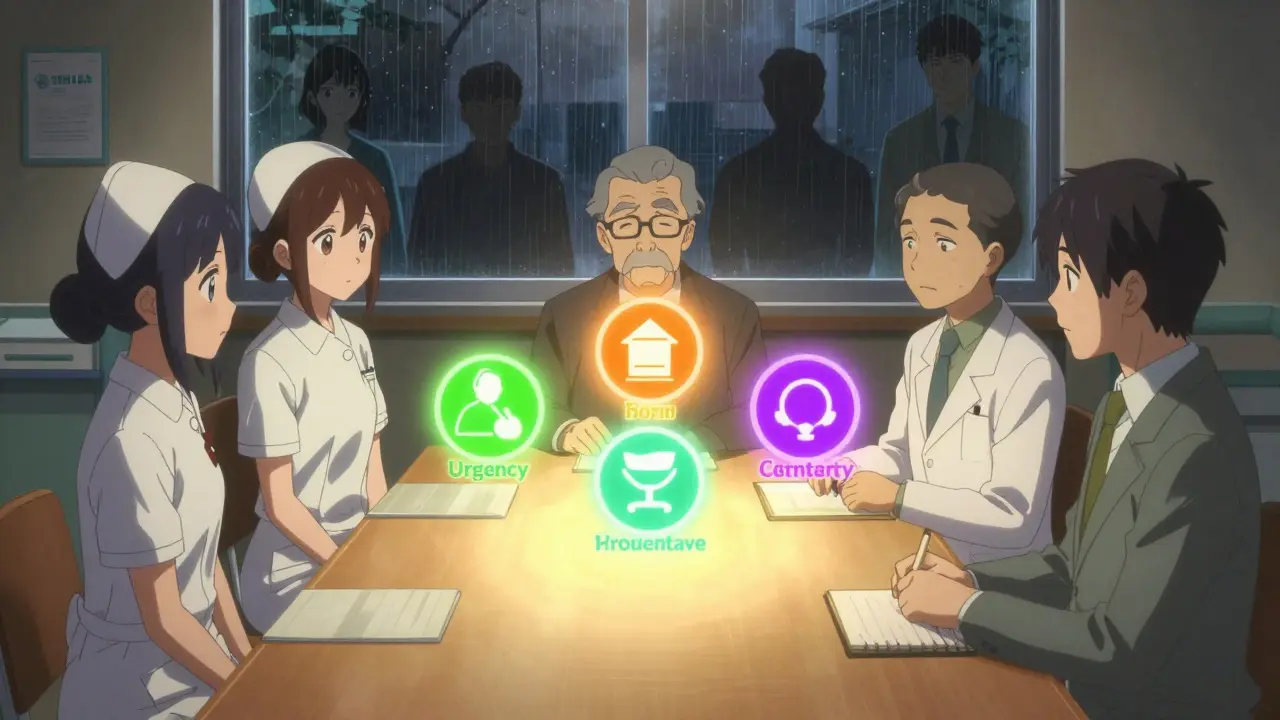
Different hospitals use different rules. But most follow a set of five core criteria, first outlined in the American Journal of Bioethics a 2012 framework that defines five key allocation principles for scarce medical resources:- Urgency of need: Who will die without this drug right now?
- Chance of benefit: Who is most likely to respond?
- Duration of benefit: Will this drug extend life for months - or just weeks?
- Years of life saved: Should we prioritize a 25-year-old over a 75-year-old if both have equal survival chances?
- Instrumental value: Should frontline workers get priority? (Some hospitals do, especially during pandemics.)
- Tier 1: Curative intent treatment with no alternative. (e.g., a young patient with testicular cancer who can’t be treated with anything else.)
- Tier 2: Palliative intent with high survival benefit. (e.g., someone with advanced ovarian cancer where this drug improves survival by 4-6 months.)
- Tier 3: Maintenance therapy or low-benefit use. (e.g., routine follow-up dosing with minimal impact.)
The Gap Between Policy and Practice
Here’s the hard truth: most hospitals don’t follow these rules. A 2022 survey of 247 pharmacy managers found that 51.8% of rationing decisions were made at the bedside - by one doctor, with no committee, no oversight. Only 13.3% of hospitals had committees that included physicians. Just 2.8% included ethicists. And only 4.9% had anyone trained in ethics. That’s dangerous. Bedside rationing leads to inconsistent outcomes. One hospital might prioritize younger patients. Another might give priority to those who arrived first. A third might favor patients with better insurance. No standard. No transparency. Worse, 64% of patients were never told their treatment was rationed. A 2021 Patient Advocate Foundation study recorded 127 formal complaints from families who only found out after the fact - or never at all. Even when committees exist, they’re slow. It takes an average of 72 hours from the time a shortage is declared to when the committee meets. In emergency cases - like a patient in septic shock needing an antibiotic - that delay can be fatal.Who Gets Left Behind?
The biggest failure of current rationing systems? They ignore equity. A 2021 Hastings Center Report found that 78% of hospital rationing protocols don’t include any explicit measures to protect marginalized groups - Black, Hispanic, low-income, or rural patients. Why does this matter? Because these groups are already more likely to face delays in care, less access to specialists, and fewer resources to navigate complex systems. Rural hospitals are hit hardest. A 2022 ASHP survey showed 68% of rural facilities had no formal rationing plan. Meanwhile, academic medical centers - with ethicists, pharmacists, and social workers on staff - were far more likely to have structured protocols. And then there’s the hoarding. A 2018 survey found that 68% of hospitals reported departments - like oncology or ICU - hoarding drugs, keeping extra vials for their own patients, even when others were in crisis. It’s not greed. It’s fear. But it makes the shortage worse for everyone.
What’s Being Done to Fix It
Change is coming - slowly. In 2023, ASCO launched a free online decision tool to help oncologists navigate shortages. The CDC updated its Crisis Standards of Care toolkit. The FDA announced plans for an AI-powered early warning system by 2025, aiming to predict shortages before they happen. The most promising development? Certification for hospital ethics committees. In January 2024, pilot programs began in 15 states to train and certify these teams. They’ll be required to follow national standards, include ethicists, document every decision, and report outcomes. Hospitals that have adopted full protocols - with committees, training, and transparency - report:- 32% fewer disparities in who gets treatment
- 41% lower clinician moral distress
- 89% improvement in patient communication
What Patients and Families Should Know
If you or a loved one is facing a drug shortage, ask these questions:- Is there an alternative medication? (Sometimes a different drug works just as well.)
- Can we adjust the dose or schedule? (Lower doses given less often can still be effective.)
- Has a committee reviewed this decision? (If not, ask why.)
- Am I being told the truth about why I’m not getting this drug?
What Needs to Change
This isn’t just a medical problem - it’s a systemic one. We can’t keep relying on hospitals to make impossible choices with no support. We need:- National standards: One set of rules for all hospitals, not 5,000 different ones.
- Manufacturer accountability: Require more than 68% of drugmakers to report shortages early.
- Investment in supply chains: Diversify production. Don’t let three companies control 80% of critical drugs.
- Training for all clinicians: Ethics training shouldn’t be optional. It should be mandatory.
Is it legal to ration medications?
Yes, but only under specific ethical and institutional guidelines. There’s no federal law that bans rationing, but hospitals must follow professional standards set by organizations like ASHP and ASCO. Rationing becomes illegal if it’s based on discrimination - such as race, income, or insurance status - or if patients aren’t informed. The key is transparency, consistency, and fairness.
Why don’t more hospitals have ethics committees for drug shortages?
Budgets, staffing, and lack of leadership support. Many hospitals see ethics committees as optional, not essential. Setting up a committee requires training, time, and money - resources that are already stretched thin. Only 36% of hospitals had standing committees as of 2018. Even fewer include ethicists or patient advocates. Without mandatory standards, there’s little incentive to change.
Can patients appeal a rationing decision?
In theory, yes - if the hospital follows the Accountability for Reasonableness framework. Patients should be told how to request a review. In practice, only 18% of hospitals have a documented appeals process. Most patients don’t know they can ask. Clinicians often don’t know how to guide them. That’s why transparency isn’t just ethical - it’s necessary for trust.
Are there alternatives to rationing drugs?
Yes - and hospitals should try them first. The American Journal of Bioethics recommends a three-step approach: (1) Conservation - use lower doses or extend intervals; (2) Substitution - switch to another effective drug; (3) Rationing - only if the first two fail. Many shortages can be avoided if hospitals use these steps early. But too often, they wait until the last vial is gone.
What can I do if my hospital doesn’t have a rationing plan?
Ask for a meeting with the pharmacy director or ethics committee. Bring data - mention ASCO’s 2023 guidelines and the fact that 82% of hospitals have some kind of shortage policy. Advocate for a committee with patient input. You’re not asking for special treatment - you’re asking for fairness. And that’s a right, not a privilege.
Sally Lloyd
March 15, 2026 AT 04:30So let me get this straight - we’re letting three companies control 80% of life-saving injectables, and we’re surprised when things fall apart? 😏 This isn’t a shortage. This is a feature. The system was designed to fail quietly so the shareholders could keep their dividends. I’ve seen the memos. They call it ‘strategic scarcity.’
Emma Deasy
March 15, 2026 AT 09:14Oh. My. GOSH. Did you SEE that 64% of patients were NEVER TOLD their treatment was rationed?!?!? This is not healthcare - this is a moral catastrophe wrapped in a PowerPoint presentation. I’m literally shaking. Someone call the media. Someone call the Senate. Someone call my therapist. THIS IS UNACCEPTABLE.
tamilan Nadar
March 15, 2026 AT 15:52In India, we ration medicines daily - no committees, no forms, just the pharmacist saying 'this is all we have.' Sometimes it works. Sometimes it doesn't. But at least we don't pretend it's about fairness. Here, you build whole frameworks to hide the fact that money decides who lives. The real ethics? That's not in the policy. It's in the silence.
Adam M
March 16, 2026 AT 14:45Stop pretending this is ethical. It’s triage. And triage means someone dies. Stop romanticizing committees. Doctors have been making these calls since 1943. Let them do their job.
Rosemary Chude-Sokei
March 16, 2026 AT 15:06I truly appreciate the depth of this analysis. The data is overwhelming, and yet, I find myself wondering - if transparency and appeals are core to the framework, why do we continue to allow them to be optional? It feels like we’re asking hospitals to follow a recipe while refusing to supply the ingredients. The gap between policy and practice isn’t just a flaw - it’s a betrayal of trust.
Noluthando Devour Mamabolo
March 17, 2026 AT 11:47Let’s not ignore the structural inequity here 🤔 The fact that rural hospitals lack even a baseline protocol? That’s not an oversight - it’s a policy outcome. We’ve built a two-tier system: elite academic centers with ethicists on retainer, and everyone else left to Google ‘cisplatin alternatives’ at 2 a.m. #HealthcareIsNotAHoliday
Lorna Brown
March 19, 2026 AT 10:26What if the real ethical question isn’t who gets the drug - but why we’re forced to choose at all? We accept rationing as inevitable because we’ve stopped asking who benefits from the shortage. The answer isn’t in committees. It’s in supply chains, patents, and corporate greed. We’re treating symptoms while the disease spreads.
Rex Regum
March 20, 2026 AT 07:36Oh, so now we’re supposed to trust ‘ethicists’? Like the same people who told us ‘flatten the curve’ while hospitals were turning away cancer patients? This is virtue signaling dressed in a lab coat. The real solution? Let the market work. If people want the drug, they’ll pay for it. No more handouts. No more bureaucracy. Just freedom.
Kelsey Vonk
March 22, 2026 AT 07:03I just… I don’t know how to feel anymore. I work in oncology. I’ve watched people cry because their dose got cut in half. I’ve held hands during infusions when we didn’t have enough. We don’t talk about it. We can’t. But this post? It made me cry. Not because it’s new - because it’s true. And nobody’s listening.
Emma Nicolls
March 23, 2026 AT 07:01So many hospitals dont even have a plan?? That's wild. I mean, if you're gonna run out of chemo drugs, shouldn't you have a backup? Like, duh? I'm just saying. Maybe we need to start talking about this more? Like, at dinner? With friends? 🤷♀️
Jimmy V
March 24, 2026 AT 18:18Conservation > Substitution > Rationing. That’s the only triage protocol that matters. Stop hoarding. Stop waiting. Start using 80% of the dose. You’re not saving vials - you’re saving lives. And yes, I’ve done it. No one died. No one sued. Just better outcomes.
Richard Harris
March 26, 2026 AT 04:35Interesting piece. I think the real issue is how we measure 'benefit'. If a 75-year-old has a 40% chance of living 18 months with the drug, and a 25-year-old has a 45% chance of living 20 years - is it really fair to pick the younger one? We’re not just saving years. We’re saving potential. And potential is a slippery thing.
Kandace Bennett
March 26, 2026 AT 23:51Finally! Someone who gets it. 🇺🇸 This is why America is better. We have frameworks. We have committees. We have standards. Other countries? They just give drugs to whoever screams loudest. Here? We have ethics. We have dignity. We have… well, we have problems - but at least we’re trying. 💪❤️🇺🇸