
Multiple Myeloma: Understanding Bone Disease and the New Drugs Changing Outcomes

When someone is diagnosed with multiple myeloma, the focus often lands on the cancer cells multiplying in the bone marrow. But for most patients, the real daily struggle isn’t just the cancer-it’s the bone disease that comes with it. Over 80% of people with multiple myeloma develop severe bone damage, leading to fractures, unbearable pain, and hospital stays. For decades, treatment only tried to slow the damage. Now, new drugs are finally starting to reverse it.
Why Myeloma Destroys Bones
Multiple myeloma doesn’t just sit in the bone marrow-it actively attacks the bones. Healthy bones are constantly being rebuilt: old bone is broken down by cells called osteoclasts, and new bone is built by osteoblasts. In myeloma, this balance shatters. Osteoclasts go into overdrive, chewing up bone like a runaway machine. Meanwhile, osteoblasts are shut down-stuck in neutral. The result? Holes in the bones, called osteolytic lesions, that show up like punched-out circles on X-rays.
This isn’t random damage. Myeloma cells release chemicals that trigger the destruction. One key player is RANKL, a protein that tells osteoclasts to activate. Myeloma cells flood the bone marrow with RANKL while blocking OPG, the natural brake. The RANKL-to-OPG ratio in patients can be three to five times higher than in healthy people. Another villain is DKK1, a protein secreted by myeloma cells that shuts off the Wnt signaling pathway-the body’s main signal for bone building. Patients with DKK1 levels above 48.3 pmol/L have more than three times the number of bone lesions compared to those with lower levels.
Even the bone’s own cells, osteocytes, get pulled into the fight. These cells make up 95% of all bone cells and normally help maintain bone strength. In myeloma, they start releasing sclerostin, another bone-building blocker. Studies show sclerostin levels in myeloma patients average nearly 29 pmol/L-almost 50% higher than in healthy individuals.
The Vicious Cycle No One Talked About
Here’s what makes this so dangerous: bone destruction doesn’t just cause pain-it feeds the cancer. When bone breaks down, it releases growth factors like IGF-1 and TGF-beta that myeloma cells love. These nutrients make the cancer cells grow faster, which in turn makes them release even more destructive proteins. It’s a loop: cancer destroys bone, bone breakdown feeds cancer, and the cycle gets worse.
Doctors used to treat the cancer and hope the bones would hold up. Now we know that’s not enough. The bone environment isn’t just a casualty-it’s an active participant. Targeting only the cancer cells leaves the bone damage unchecked, and the cancer keeps coming back stronger.
What’s Been Used So Far: Bisphosphonates and Denosumab
For years, the only tools doctors had were bisphosphonates-drugs like zoledronic acid and pamidronate. Given as monthly IV infusions, they slow down osteoclasts. They reduce skeletal-related events (fractures, spinal cord compression, need for radiation) by about 15-18% compared to no treatment. But they don’t rebuild bone. They just slow the decay.
Denosumab, approved in 2010, works differently. It’s a monoclonal antibody that directly blocks RANKL. It’s given as a monthly shot under the skin, which many patients prefer over IVs. Studies show it’s at least as effective as bisphosphonates at preventing fractures. A 2021 Mayo Clinic survey found 74% of patients preferred denosumab because it’s easier to get-no hospital visits, no IV lines.
But there are downsides. Both drugs can hurt the kidneys. About 22% of patients on zoledronic acid need dose adjustments because their creatinine clearance drops below 60 mL/min. Denosumab doesn’t affect kidneys, but it can cause severe hypocalcemia-low calcium-especially if patients aren’t taking enough vitamin D and calcium. And then there’s MRONJ: medication-related osteonecrosis of the jaw. Around 42% of patients on long-term bone drugs report needing dental procedures because their jawbone starts dying. That’s why every patient gets a dental checkup within 30 days of starting treatment.
The New Wave: Drugs That Actually Heal Bone
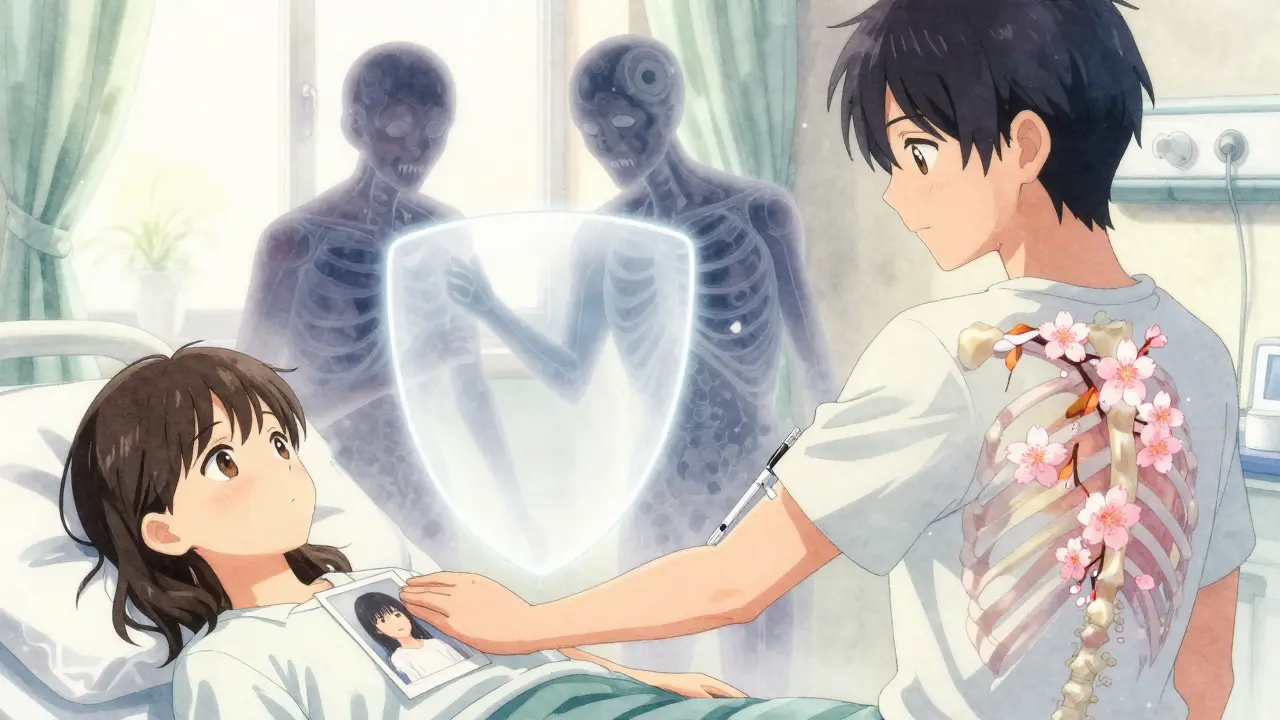
The real breakthrough isn’t just stopping bone loss-it’s making bone grow again. That’s where novel agents come in.
One of the most promising is romosozumab, an antibody that blocks sclerostin. By disabling this bone-building blocker, it lets osteoblasts wake up and start making new bone. In a 2021 phase II trial called STRUCTURE, 49 myeloma patients on romosozumab saw a 53% increase in bone mineral density at the spine after just one year. Pain scores dropped by 35%. For the first time, patients weren’t just surviving-they were getting stronger.
Blosozumab, another anti-sclerostin drug, showed similar results in early trials. And then there’s DKN-01, which targets DKK1. In a 2020 trial with 32 patients, DKN-01 reduced bone resorption markers by 38%. It didn’t just slow damage-it turned the tide.
Even drugs that target the Notch pathway, like nirogacestat, are showing promise in animal models. In lab studies, they cut osteolytic lesions by 62%. Human trials are just starting, but the early signals are strong.
These aren’t just lab curiosities. The FDA approved a new low-dose version of zoledronic acid in April 2023 (Zometa-LD) to reduce kidney damage. And the phase III BONE-HEAL trial, now recruiting 450 patients, is testing whether romosozumab can prevent fractures and improve survival in the long term.
Who Benefits Most-and Why
Not every myeloma patient needs these new drugs yet. Right now, they’re mostly used in clinical trials or for those who’ve already had fractures or are at very high risk. But experts agree: early intervention is key. Waiting until a bone breaks is too late.
Dr. Irene Ghobrial at Harvard says, “Targeting both the tumor and the bone environment is essential.” That means combining new bone drugs with myeloma treatments like proteasome inhibitors or immunomodulatory drugs. The goal isn’t just longer life-it’s better life. Fewer hospital stays. Less pain. The ability to walk without fear of breaking a rib.
But there’s a catch. These drugs are expensive. Denosumab costs about $1,800 per dose. Generic zoledronic acid is $150. Anti-sclerostin drugs aren’t yet approved for myeloma, so they’re not covered by insurance outside trials. In the U.S., denosumab is used in 78% of cases. In Europe, it’s only 42%. In Asia, bisphosphonates still dominate at 89%.
What Patients Are Saying
On patient forums like Myeloma Crowd, stories are mixed. One woman wrote: “I’ve been on zoledronic acid for three years. My bones still ache. I had two fractures. I’m scared to bend over.” Another said: “I switched to denosumab. No more IVs. My calcium is fine. I feel like I have some control back.”
Patients in clinical trials for romosozumab report the most dramatic changes. One man in the STRUCTURE trial said, “I started walking again. I held my granddaughter without pain for the first time in years.”
But side effects are real. Anti-sclerostin drugs can cause low calcium-12.3% of trial participants needed supplements. Gamma-secretase inhibitors cause severe rashes in two-thirds of users. Monitoring is critical.
What’s Next: Healing, Not Just Protecting
The future isn’t just about more drugs-it’s about smarter use. Researchers are now looking at bone turnover markers to predict who will respond best. Are your DKK1 levels high? Then DKN-01 might help. Is your sclerostin sky-high? Romosozumab could be your best shot.
Bispecific antibodies are also in early trials-drugs that grab both myeloma cells and bone-strengthening proteins at the same time. RNA therapies like Alnylam’s ALN-DKK1 are showing 65% DKK1 reduction in preclinical models. Personalized bone health plans are coming.
Dr. Brian Durie of the International Myeloma Foundation predicts: “By 2030, we won’t just prevent bone damage-we’ll heal it.” That’s the goal. No more holes in the bones. No more fractures. No more hospitalizations because of a simple fall.
The tools are finally here. The question isn’t whether they work-it’s how fast we can make them available to everyone who needs them.
Is bone damage in multiple myeloma reversible?
For decades, bone damage in multiple myeloma was considered permanent. Current treatments like bisphosphonates and denosumab only slow further loss. But new drugs targeting sclerostin and DKK1 are now showing the ability to rebuild bone. In clinical trials, patients using romosozumab saw up to a 53% increase in bone mineral density within a year. This suggests that, for the first time, bone healing is possible-not just prevention.
What’s the difference between denosumab and zoledronic acid?
Denosumab is a monthly injection under the skin that blocks RANKL, a key protein that activates bone-destroying cells. Zoledronic acid is a monthly IV infusion that directly kills osteoclasts. Both reduce fractures by about the same amount. But denosumab doesn’t affect kidney function, making it safer for patients with reduced kidney health. Zoledronic acid can cause kidney damage, requiring dose adjustments in 22% of patients. Denosumab is more convenient but costs about 12 times more per dose.
Why do I need a dental checkup before starting bone treatment?
Bisphosphonates and denosumab can cause a rare but serious condition called medication-related osteonecrosis of the jaw (MRONJ). This happens when the jawbone stops healing after dental procedures like extractions. The risk is higher if you have poor dental health or get invasive work done while on treatment. A dental exam before starting therapy lets your dentist fix problems like loose teeth or gum disease first. It’s a simple step that can prevent years of pain and surgery later.
Can I stop bone drugs if my myeloma goes into remission?
No-not yet. Even if your cancer is under control, the bone environment stays damaged. Stopping bone drugs too soon increases fracture risk. Current guidelines recommend continuing monthly treatment as long as you’re on active myeloma therapy. For patients in long-term remission, doctors may consider reducing frequency (like every 3 months), but stopping completely is not advised until more data proves it’s safe. Always consult your oncologist before making changes.
Are these new bone drugs available to everyone?
Not yet. Drugs like romosozumab and DKN-01 are still in clinical trials for multiple myeloma. They’re approved for osteoporosis, but not yet for myeloma bone disease. Access is limited to patients enrolled in trials or those with special insurance approvals. Denosumab and zoledronic acid are widely available, but cost and insurance coverage vary. In the U.S., denosumab is commonly used; in Asia, bisphosphonates still dominate. The goal is to get these new healing drugs approved and covered by insurance within the next 2-3 years.
Kelly Gerrard
December 31, 2025 AT 01:20The bone destruction in myeloma isn't just a side effect-it's the core problem and we've been treating the symptom not the disease for decades. Finally the science is catching up. Romosozumab isn't just promising-it's revolutionary. We need this everywhere, not just in trials. Stop waiting for perfect data and start saving lives now.
Colin L
January 1, 2026 AT 15:57You know what's really heartbreaking? I had a cousin who got diagnosed with this in 2018. She was 42. She got the IV zoledronic acid every month, spent half her life in infusion centers, and still ended up with three compression fractures. Her spine collapsed so bad she couldn't sit up without screaming. She asked me once, 'Why do they call this treatment if it just makes me slower to die?' And I didn't have an answer. Now I do. These new drugs? They're not just science-they're hope. I cried reading about that man holding his granddaughter again. I wish I could've told her this was coming.
srishti Jain
January 2, 2026 AT 13:48Cheyenne Sims
January 3, 2026 AT 02:56It is imperative to recognize that the current standard of care for myeloma bone disease remains firmly rooted in evidence-based medicine. While novel agents demonstrate intriguing preliminary results, extrapolating phase II data into clinical practice without phase III validation constitutes a dangerous precedent. The FDA has not approved romosozumab for this indication. To prematurely advocate for widespread use is to prioritize emotion over evidence.
Shae Chapman
January 3, 2026 AT 18:34THIS. IS. HUGE. 🙌 I’ve been waiting for this my whole life. My dad’s been on denosumab since 2020 and he finally started walking without a cane last month. He planted a garden. He’s dancing with my mom again. 💔➡️💖 I’m not crying, you’re crying. This is what medicine should look like.
Nadia Spira
January 3, 2026 AT 19:24Let’s be real: the entire osteoclast/osteoblast paradigm is a reductive reductionist fantasy. You’re treating biomarkers like they’re causative agents. Sclerostin inhibition? DKK1 blockade? These are downstream epiphenomena. The real pathology is the systemic immune dysregulation and metabolic rewiring of the tumor microenvironment. We’re rearranging deck chairs on the Titanic while the real enemy-the clonal evolution of plasma cells-is silently acquiring epigenetic resistance. Until we target the stem cell niche, you’re just delaying the inevitable with expensive biologics. This isn’t healing-it’s palliative pharmacology dressed up as breakthrough.
henry mateo
January 5, 2026 AT 05:44hey i just read this and wanted to say thanks. my uncle just started romosozumab in a trial and his pain went from 8/10 to 3/10 in 3 weeks. he said he slept through the night for the first time in 4 years. i dont know much about science but i know what i see. keep going guys. you’re changing lives.
Kunal Karakoti
January 5, 2026 AT 16:05There’s a philosophical tension here between healing and preventing. If we heal bone, are we merely restoring function, or are we altering the very architecture of survival? The body doesn’t heal in isolation-it responds to systemic pressure. Perhaps the real breakthrough isn’t the drug, but the realization that the bone is not a passive victim but an active participant in the disease narrative. We’ve been treating a battlefield while ignoring the war council. Maybe the cure lies not in blocking signals, but in listening to them.
Glendon Cone
January 6, 2026 AT 00:24Just saw the BONE-HEAL trial info. 450 patients? That’s massive. And the fact they’re tracking survival, not just bone density? That’s the real win. I’m a nurse in oncology-seen too many patients lose their mobility, their dignity. These drugs? They’re not just meds. They’re freedom. Keep pushing for access. And yeah, I’m gonna cry again reading about the granddaughter thing. 🥹❤️
Henry Ward
January 6, 2026 AT 07:12Of course it’s expensive. You think real science comes cheap? People who can’t afford denosumab shouldn’t be getting treatment at all. If you can’t pay for the cure, you shouldn’t be in the game. This isn’t a public utility-it’s cutting-edge medicine. Stop demanding equity. Demand better insurance. Or don’t get sick.