
How to Read Prescription Dosage Instructions: Frequency and Timing Explained
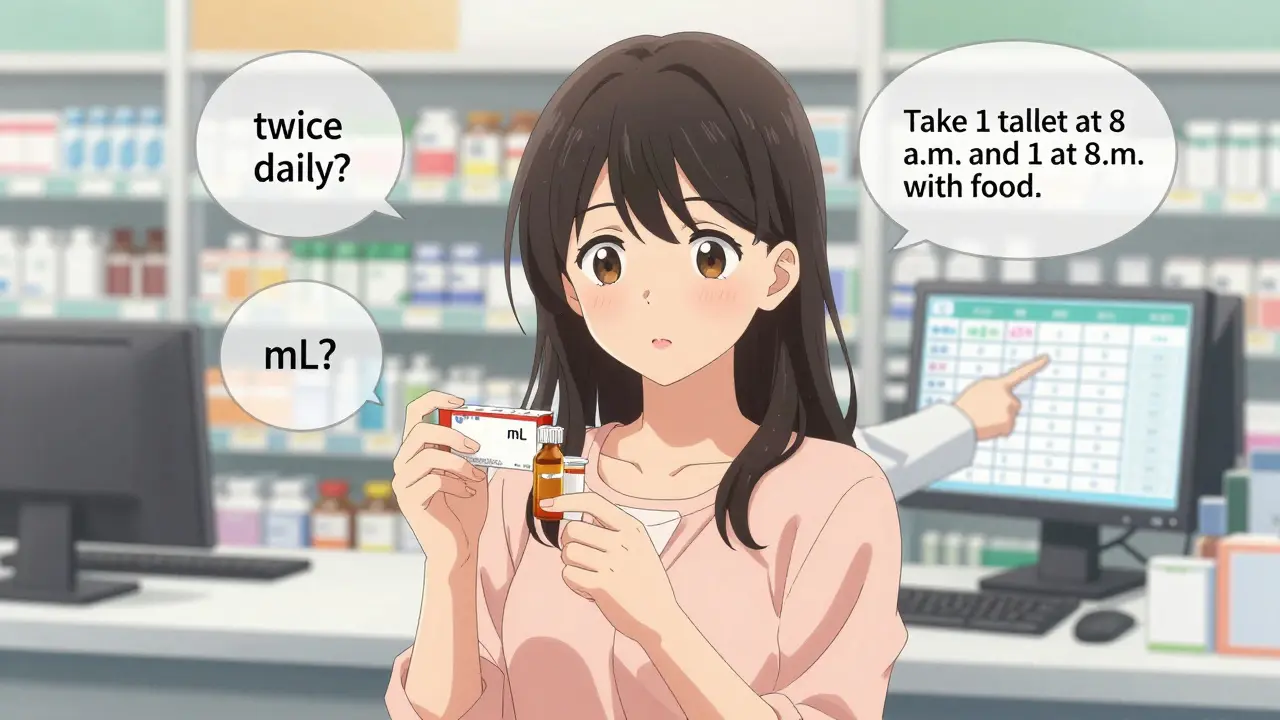
When you pick up a prescription, the tiny print on the label might seem like a code you’re supposed to crack. Prescription dosage instructions aren’t just suggestions-they’re safety rules. Get them wrong, and you could be underdosing, overdosing, or causing harmful side effects. The good news? You don’t need a pharmacy degree to understand them. This guide breaks down exactly what those words mean, why they matter, and how to make sure you’re taking your medicine the right way.
What "Twice Daily" Really Means
You’ve seen it: "Take 1 tablet twice daily." It sounds simple, right? But here’s the problem-most people don’t know what "twice daily" actually means in real time. Is it morning and night? Every 12 hours? Or just whenever you remember? The FDA recommends avoiding vague terms like "twice daily" altogether. Instead, labels should say: "Take 1 tablet in the morning and 1 tablet in the evening." Why? Because timing affects how well the drug works-and how safe it is. For example, antibiotics like amoxicillin need steady levels in your blood to kill bacteria. If you take both doses at once, the drug spikes too high, then drops too low. That’s not just ineffective-it can lead to antibiotic resistance. On the other hand, blood pressure meds like lisinopril work best when taken at the same time each day. Taking one in the morning and one at midnight? That’s not what your doctor meant. A 2021 study at Massachusetts General Hospital found patients who got labels saying "Take with breakfast and dinner" were 35% more likely to stick to their schedule than those who just saw "Take twice daily." The difference? Specificity.Why "As Needed" Can Be Dangerous
"Take as needed for pain" sounds flexible. But without a maximum daily limit, it’s a recipe for trouble. Take acetaminophen (Tylenol). Many people don’t realize that even over-the-counter painkillers can cause liver damage if taken too often. The FDA limits acetaminophen to 3,000-4,000 mg per day, depending on the person. But if your label just says "take as needed," you might not know how many pills that equals. One pill might be 325 mg. Another might be 500 mg. Without clear instructions, you could accidentally take 10 pills in a day. Consumer Reports found that 68% of people who used "as needed" pain meds didn’t know the daily maximum. That’s not carelessness-it’s a labeling failure. The fix? Labels should say: "Take 1 tablet every 6 hours as needed for pain. Do not exceed 4 tablets in 24 hours." That’s clear. That’s safe.The Unit Mix-Up: Teaspoons vs. Milliliters
If you’re giving medicine to a child-or even taking liquid medicine yourself-this one can be deadly. For years, prescriptions used "teaspoon" or "tablespoon" for liquid doses. But a teaspoon from your kitchen isn’t the same as a medical teaspoon. A standard measuring spoon holds 5 mL, but many people use household spoons that vary by 20-30%. That’s a huge difference when you’re giving a baby 5 mL of antibiotics. The FDA and U.S. Pharmacopeia now require all liquid medications to use milliliters (mL) on labels. But here’s the catch: a 2021 FDA audit found 64% of retail pharmacy labels still used "teaspoon" or "tbsp." Even worse, NIH research showed patients using non-metric units made measurement errors 27% of the time. Always check the label. If it says "take 5 tsp," ask the pharmacist to rewrite it in mL. And never use a kitchen spoon. Use the measuring cup or syringe that came with the medicine.
Timing Matters More Than You Think
Some meds need to be taken on an empty stomach. Others need food to reduce nausea. Some need to be spaced evenly. Ignoring this can ruin the whole treatment. Take levothyroxine, the thyroid hormone pill. It’s absorbed best when taken first thing in the morning, 30-60 minutes before eating. But a Harvard Health study found 33% of patients took it with breakfast-cutting its effectiveness in half. Metformin, used for diabetes, causes stomach upset. Taking it with food reduces side effects. A patient on PatientsLikeMe said switching from "take 2 tablets daily" to "take 1 with breakfast and 1 with dinner" cut their nausea by half. Even timing within the day matters. Blood thinners like warfarin work best when taken at the same time every day. If you take it at 8 a.m. one day and 9 p.m. the next, your blood clotting levels swing unpredictably. That’s why oncology drugs now require exact windows: "Take between 8:00-10:00 a.m."What the Abbreviations Really Mean (And Why They’re Bad)
You might see "b.i.d." or "t.i.d." on old labels. Those are Latin abbreviations: "bis in die" (twice daily) and "ter in die" (three times daily). The American Medical Association says only 37% of patients understand these. That’s why they’re being phased out. The FDA’s 2014 guidance says to spell everything out: "Take twice daily," not "b.i.d." But you’ll still see them. If you do, ask the pharmacist to translate it. Don’t guess.Why Your Pharmacy Might Be Getting It Wrong
You’d think pharmacies would follow FDA rules. But they don’t always. CVS Health updated its systems in 2022 and now uses explicit timing on 93% of prescriptions. Walgreens? Only 38%. Independent pharmacies? Just 28%. Why the gap? Time. Pharmacists are busy. Converting "twice daily" to "morning and evening" takes 2-4 extra minutes per prescription. A 2023 survey found 68% of pharmacists say they don’t have enough time. But the real issue? Computer systems. Most pharmacy software still defaults to old abbreviations. Even big systems like Epic only have 5 out of 2,347 clinics fully set up for clear timing instructions. The good news? Surescripts and NCPDP now offer a standardized digital format for timing instructions. It’s being used by 93% of U.S. pharmacies. But it’s only as good as the person entering the data.
What You Can Do Right Now
You don’t have to wait for pharmacies to fix everything. Here’s how to protect yourself:- Ask for clarity. When you get your prescription, say: "Can you write out exactly when I should take this?"
- Check the units. If it says "teaspoon," ask for mL. Use the syringe that came with it.
- Write it down. Copy the label onto your phone or a sticky note: "Take 1 tablet at 8 a.m. and 1 at 8 p.m. with food."
- Know the max. For "as needed" meds, ask: "What’s the most I can take in 24 hours?"
- Use a pill organizer. One with morning, afternoon, evening, and night slots helps you stay on track.
The Future: Labels That Show You How
The FDA is testing something new: augmented reality labels. Scan the QR code on your pill bottle with your phone, and a video shows you exactly when and how to take the medicine. In a 6-month trial, this cut timing errors by over 50%. It’s not everywhere yet-but it’s coming. By 2027, all new prescriptions may include a "Medication Schedule Grid," a simple chart showing each dose for the week. No more guessing. Until then, you’re your own best safety net. Don’t assume. Ask. Double-check. Write it down.What If You Miss a Dose?
This comes up all the time. You forget. You’re late. You’re not sure what to do. There’s no universal rule. It depends on the drug. For most daily meds: If you remember within 8 hours, take it. If it’s been longer, skip it. Don’t double up. For antibiotics: If you miss one, take it as soon as you remember-even if it’s not the exact time. Then go back to your normal schedule. For insulin or blood thinners: Call your doctor. These are high-risk meds. Never guess. When in doubt, call your pharmacy. They’re there to help.What does "twice daily" mean on a prescription?
"Twice daily" means two doses per day, but it doesn’t say when. For safety, it should be rewritten as "Take one tablet in the morning and one in the evening." This ensures even spacing and better effectiveness. Taking both doses close together can cause side effects or reduce the drug’s benefit.
Can I take my medicine with food if it says "take on an empty stomach"?
No. Some medications, like levothyroxine or certain antibiotics, are absorbed much less effectively if taken with food. Food can block absorption or change how the drug works. If your label says "take on an empty stomach," wait at least 30-60 minutes before eating. If you’re unsure, ask your pharmacist.
Why do some labels use "mL" and others use "teaspoon"?
By law, oral liquid medications should use milliliters (mL) to avoid measurement errors. But many pharmacies still use "teaspoon" because their old systems haven’t been updated. A kitchen teaspoon can hold anywhere from 3-7 mL, leading to dangerous overdoses or underdoses. Always ask for mL and use the syringe provided-not a kitchen spoon.
What should I do if my prescription says "as needed"?
Always ask: "What’s the maximum amount I can take in 24 hours?" Many "as needed" drugs, like acetaminophen or ibuprofen, have strict daily limits. Exceeding them can cause liver damage or stomach bleeding. Write down the max dose and stick to it-even if you still feel pain.
I’m a night shift worker. How do I follow "morning and evening" instructions?
"Morning" and "evening" are based on a 24-hour day, not daylight. If you work nights, your "morning" is when you wake up, and your "evening" is when you go to bed. For example, if you sleep during the day, take your dose when you wake up (your morning) and again when you prepare to sleep (your evening). Tell your pharmacist your schedule-they can adjust the wording to fit your routine.
What if I accidentally take two doses at once?
Don’t panic, but don’t ignore it either. Call your pharmacist or doctor right away. For most medications, one extra dose won’t cause serious harm-but some, like blood thinners or diabetes drugs, can be dangerous. They’ll tell you whether to skip your next dose or monitor for side effects. Never take another dose to "make up" for the mistake.
Steven Destiny
December 26, 2025 AT 11:05Finally, someone breaks this down without jargon. I used to just guess with my blood pressure meds-until I ended up in the ER. Now I write everything on my phone. Simple. Life-saving.
Pro tip: Set two alarms. One for the dose, one for 10 minutes later in case you forget you already took it.
Sophia Daniels
December 27, 2025 AT 05:50OMG YES. I once gave my kid 5 tsp of amoxicillin because the label said ‘teaspoon’ and I used my coffee spoon. He turned purple. We were lucky.
Pharmacies are still living in 1998. If your label doesn’t say ‘mL’ and ‘take at 8 AM and 8 PM,’ demand a rewrite. Your life isn’t a crossword puzzle.
Fabio Raphael
December 29, 2025 AT 04:23I’ve been a nurse for 18 years, and I still see patients confused by ‘b.i.d.’ or ‘q6h.’ The system’s broken. It’s not their fault-they’re not doctors. The pharmacy’s job is to make this crystal clear.
I always print out a little card for my patients: ‘Take this at 7 AM and 7 PM. Use the syringe. No spoons.’ It’s that simple.
Amy Lesleighter (Wales)
December 30, 2025 AT 07:36my grandma took her thyroid med with her morning coffee for 12 years. she thought it was fine. turned out she was basically just wasting her money. never assume. always ask. its not hard.
Erwin Asilom
December 31, 2025 AT 02:37For anyone who works nights: your ‘morning’ is when you wake up. Your ‘evening’ is when you go to sleep. Don’t let the clock confuse you. Your body doesn’t care if it’s 3 AM or 3 PM-just keep the spacing consistent.
Write it on your calendar. Sticky notes work too. I use my fridge door.
Natasha Sandra
January 1, 2026 AT 22:53😭 I didn’t know acetaminophen had a daily max! I’ve been taking 2 Tylenol every 4 hours since my back surgery. I’m so scared right now. Thanks for the wake-up call. Going to call my pharmacist NOW. 🙏
Becky Baker
January 2, 2026 AT 15:49lol pharmacies still using tsp? what is this, 2003? my cousin’s kid got overdosed because the label said ‘1 tsp’ and the mom used a soup spoon. kid ended up in ICU. this isn’t just inconvenient-it’s deadly.
Rajni Jain
January 3, 2026 AT 12:22i live in india and we dont even have proper labels most times. my mom gets her meds from the local chemist and they just write ‘2x a day’ in hindi. i had to translate it to ‘8 am and 8 pm’ and draw a little clock. people need this info everywhere, not just in the us.
roger dalomba
January 3, 2026 AT 19:27Wow. A whole article about not using ‘twice daily.’ Did we really need 1,200 words to tell us to read the label? Next up: ‘How to Use a Spoon.’
Brittany Fuhs
January 4, 2026 AT 17:53It’s embarrassing that American pharmacies still haven’t standardized this. In Germany, every prescription includes a QR code that links to a video demonstration. We’re lagging behind because of bureaucratic inertia-and laziness. Shameful.
Peter sullen
January 5, 2026 AT 04:13Per the FDA’s 2014 Medication Labeling Guidelines, Section 4.2, all temporal descriptors must be expressed in natural language with explicit temporal anchors (e.g., ‘morning’ = 06:00–10:00; ‘evening’ = 17:00–21:00) to mitigate circadian variability in pharmacokinetics. The use of Latin abbreviations violates USP <1217> and is classified as a Class II medication error. Additionally, the FDA’s 2022 Adverse Event Database reports a 41% reduction in dosing errors when mL is mandated over tsp. Pharmacists must be held to ISO 13485 compliance standards for labeling integrity. This is not a suggestion-it is a regulatory imperative.
Sumler Luu
January 5, 2026 AT 09:17I appreciate this. My dad’s on 7 different meds and I help him manage them. I started using a pill organizer with AM/PM/night slots and now he doesn’t miss a dose. Small changes, big difference.
Also-never trust the pharmacy’s printed instructions. Always double-check with the pharmacist. They’re human too.
sakshi nagpal
January 6, 2026 AT 00:07This is so important. In my country, many people just take pills whenever they remember. I’ve seen people take all their meds at once because they forgot for days. Education needs to start in schools. Not just for patients-for families, too.
Nikki Brown
January 7, 2026 AT 10:47People who don’t read labels are just asking for trouble. If you can’t follow basic instructions, maybe you shouldn’t be taking prescription meds at all. 🙄
Sandeep Jain
January 8, 2026 AT 14:31my uncle died from liver failure from too much tylenol. he thought ‘as needed’ meant ‘whenever it hurts.’ no one told him the max. this article saved my life. i’m going to print this out and show everyone i know.