
Diabetes Technology: CGMs, Smart Pens, and Apps That Help

For years, managing diabetes meant poking your finger several times a day, staring at numbers on a small screen, and guessing what your blood sugar would do next. It was stressful, unpredictable, and exhausting. Now, a quiet revolution is happening - not with a new drug, but with technology that gives people with diabetes real-time insight into their bodies. Continuous Glucose Monitors (CGMs), smart insulin pens, and smart apps aren’t just gadgets. They’re changing how people live with diabetes - reducing fear, preventing emergencies, and even saving lives.
How CGMs Changed Everything
Before CGMs, the only way to know your blood sugar was a fingerstick. You got one number, at one moment. But glucose doesn’t stay still. It spikes after meals, drops overnight, and swings during stress or exercise. Traditional HbA1c tests give a 3-month average, but they hide the details. That’s where CGMs come in.
Modern CGMs like the Abbott FreeStyle Libre 3, Dexcom G7, and Medtronic Guardian 4 take readings every 5 minutes, day and night. They don’t just show your number - they show the pattern. Are you trending up? Down? Stable? You can see it on your phone before your sugar gets too high or too low. The American Diabetes Association now recommends CGMs for everyone with Type 1 diabetes, Type 2 diabetes on insulin, pregnant people, older adults at risk for low blood sugar, and even children from diagnosis.
The numbers speak for themselves. Users gain an average of 3.2 more hours per day in their target glucose range (70-180 mg/dL) compared to fingerstick-only users. Each 10% increase in time in range cuts microvascular complications by 64%. In one real-world study, people using CGMs for just three months lowered their A1c from 10.4% to 7.5%. That’s not just a number - it’s fewer nerve pains, better kidney function, and less risk of vision loss.
And it’s not just about numbers. On Reddit’s r/diabetes community, 78% of users said CGMs improved their sleep because they got alerts when their sugar dropped at night. 63% said they felt less anxious about unexpected highs or lows. For many, it’s the first time they’ve felt in control.
What About Accuracy? The MARD Factor
Not all CGMs are created equal. Accuracy is measured by MARD - Mean Absolute Relative Difference. Lower MARD means closer to lab results. The Abbott FreeStyle Libre 3 has a MARD of 8.1%. Dexcom G7 is at 8.5%. Both are excellent. But the next leap is coming: Glucotrack, an implantable sensor still in clinical trials, has shown a MARD of 7.7%. Why does that matter?
Current CGMs measure glucose in interstitial fluid, not blood. That creates a lag of 5-15 minutes. If you’re running, eating, or having a low, the reading might not reflect what’s happening in your blood yet. Glucotrack’s implantable sensor sits under the skin and measures glucose directly from blood. No lag. No delay. It’s about the size of three nickels and designed to last up to three years. If approved, it could prevent thousands of severe low-blood-sugar events each year.
Right now, sensors last 10-14 days (Libre 3, Dexcom G7) or 7 days (Medtronic). Costs range from $150 to $300 per sensor. Insurance helps, but 37% of commercially insured patients still get denied coverage. For those without insurance, out-of-pocket costs can hit $300 a month. That’s a barrier for many - even though studies show CGMs reduce hospital visits for heart complications, especially with Abbott’s Libre system.
Smart Pens: The Missing Link
CGMs tell you what your glucose is doing. But what if you could also track what you’re doing about it? That’s where smart insulin pens come in.
The InPen by Medtronic is one of the few on the market. It records every dose, automatically logs carbs, and even suggests insulin amounts based on your CGM data. It’s like having a personal diabetes coach in your pocket. But here’s the catch: only 15% of insulin users use them. Why? Cost. Complexity. Lack of awareness.
Most people still use manual pens. They jot down doses in a notebook or forget entirely. Smart pens fix that - but they need to work with CGMs and apps to be truly powerful. Right now, only 43% of third-party diabetes apps can connect with all major CGM systems. That fragmentation is a problem. If your pen doesn’t talk to your monitor, you’re missing half the picture.
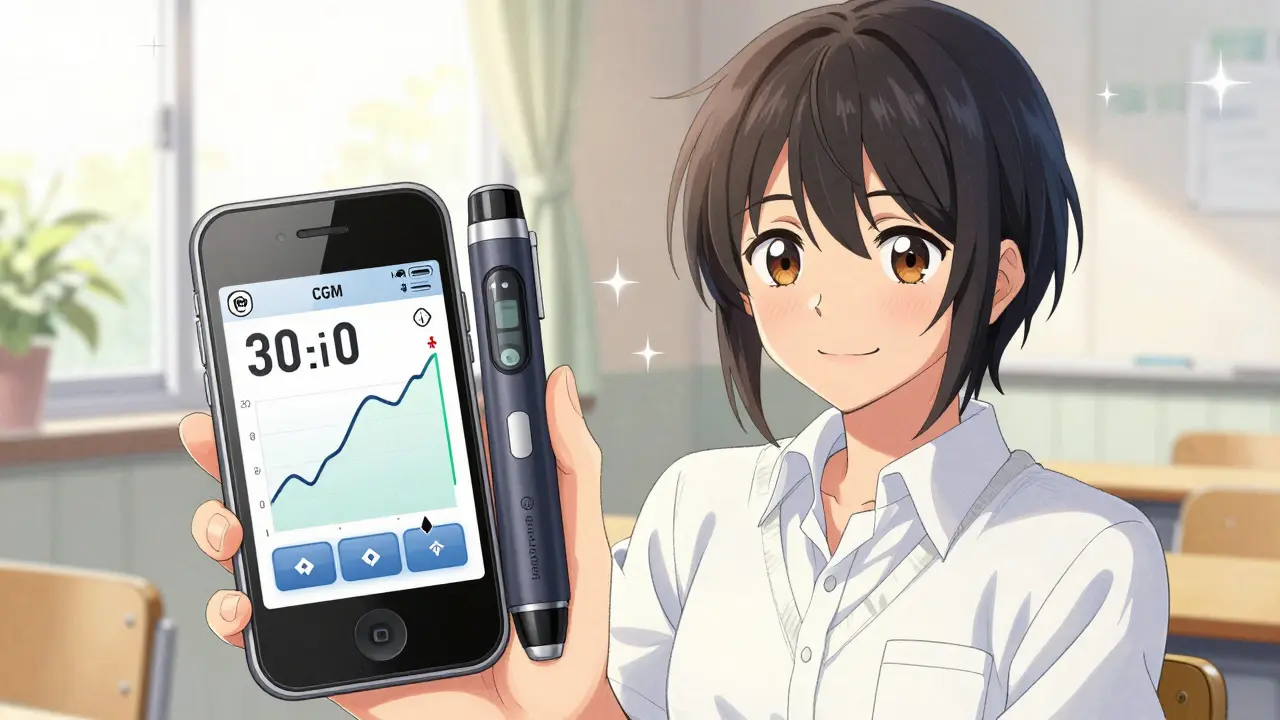
Apps: More Than Just Data Logging
Apps like mySugr and One Drop do more than store numbers. They turn data into insight. One user noticed their sugar spiked every time they ate rice - even brown rice. Another realized stress from work made their levels climb, even if they ate the same meal. These patterns are invisible without tracking.
But not all apps are equal. Some only work with one CGM brand. Others can’t export data for doctors. And many don’t support insulin dosing calculators or carb logging. The best ones let you see trends, share reports with your care team, and even set custom alerts. One study found that users who logged meals and activity for just two weeks improved their time in range by 18%.
Integration is key. The most successful users don’t just wear a CGM - they connect it to an app that talks to their smart pen, their calendar, and their doctor’s portal. That’s the future: one system, one view, one plan.
Real People, Real Results
A remote CGM program in Texas helped 120 people with Type 2 diabetes, mostly from low-income backgrounds. Many hadn’t seen a doctor in over a year. After three months of remote monitoring, 72% of foot wounds healed - compared to just 47% in the control group. A1c dropped by an average of 2.9%. Hospital visits fell by 51%.
These aren’t lab results. These are lives changed. One woman in her 60s, who used to wake up in panic every night fearing a low, now sleeps through the night. A teenager with Type 1 diabetes went from missing school to running track. A man who used to avoid social events because he didn’t know how his sugar would react now eats out without fear.
But it’s not magic. It takes work. The average person takes 2-4 weeks to fully adapt. You have to learn how to interpret trends. You have to customize alerts. Too many alarms? You’ll ignore them. Too few? You’ll miss danger. The ADA now recommends personalized settings - not one-size-fits-all. Night-shift workers need different alerts than office workers. People with low-sugar awareness need tighter ranges.

What’s Next? Predictive Tech and Implantables
The next wave isn’t just about monitoring - it’s about predicting. Dexcom and EarlySense are launching a system in Q2 2026 that uses machine learning to forecast glucose changes up to 30 minutes ahead. Imagine getting an alert that says, “Your sugar will drop in 20 minutes. Eat 15g of carbs.” That’s not science fiction. It’s coming.
Glucotrack’s implantable sensor could be the biggest leap since insulin. No patches. No wires. No daily replacements. Just a tiny device under the skin, sending real-time blood glucose data. If approved, it could become the new standard - especially for people who hate wearing devices or have skin reactions to adhesives.
And then there’s the needle-free semaglutide patch from Vaxess Technologies. Expected to enter Phase 3 trials in early 2026, it could make it easier to stick with weight-loss and blood sugar medications that require weekly injections. Better adherence means better outcomes.
The Challenges Still Left
Despite all this progress, access remains uneven. A 2025 JAMA study found 63% of CGM systems had data security flaws. Hackers could potentially alter glucose readings. That’s not theoretical - it’s a real risk.
Cost is still the biggest barrier. Even with Medicare expanding coverage, 41% of low-income patients still can’t get CGMs. Out-of-pocket costs are crushing. And many primary care doctors still don’t know how to use or recommend them. A 2025 survey found that 58% of PCPs couldn’t explain how to interpret CGM trends - even though they’re now standard of care.
Then there’s data overload. 68% of new users feel overwhelmed by alerts at first. The solution? Slow down. Customize. Start with one alert - maybe nighttime lows. Add one more after a week. Let the tech serve you, not stress you.
What Should You Do Today?
If you’re on insulin - even once a day - talk to your doctor about a CGM. It’s no longer optional. If you’re uninsured, ask about patient assistance programs. Abbott, Dexcom, and Medtronic all offer them. Some nonprofits give free sensors to those who qualify.
If you’re using a smart pen, make sure it talks to your app. If it doesn’t, switch. If you’re not using an app, start with one that’s simple - mySugr or One Drop. Log your meals, your activity, your mood. Look for patterns. Share the report with your provider.
And if you’re not sure where to start? Ask for help. Diabetes educators aren’t just for new diagnoses. They’re your roadmap through this tech maze. Most insurance plans cover 3-5 hours of diabetes education per year. Use it.
This isn’t about being tech-savvy. It’s about being informed. The goal isn’t perfect numbers - it’s fewer lows, fewer highs, and more peace of mind. The tools are here. The science is clear. Now it’s up to you to use them.
Are CGMs covered by insurance?
Yes - but it depends. Medicare now covers CGMs for people with Type 2 diabetes on insulin. Most private insurers cover them too, but many require prior authorization. If you’re denied, ask for a letter of medical necessity from your doctor. Patient assistance programs from Abbott, Dexcom, and Medtronic can also help reduce costs.
Can I use a CGM if I don’t take insulin?
Absolutely. The American Diabetes Association now recommends CGMs for all people with Type 2 diabetes, regardless of insulin use. If you’re struggling with unpredictable highs and lows, or if your A1c is above 7%, a CGM can help you understand what’s causing the swings - and how to fix them.
Do smart pens really make a difference?
Yes - if you use them. A 2025 study found that people who logged insulin doses with a smart pen were 30% more likely to stay in their target range than those who didn’t. The key is consistency. If you forget to log, it’s not helpful. But if you make it part of your routine, it becomes a powerful tool.
Which CGM is the best?
There’s no single “best.” Dexcom G7 has the most reliable app integration and longest sensor life (10 days). Abbott Libre 3 is the most affordable and has no fingerstick requirement. Medtronic Guardian 4 works best if you’re already using their insulin pump. Try to match your CGM to your lifestyle - not just the specs.
Can CGMs prevent diabetic emergencies?
Yes. Real-world data from the T1D Exchange registry shows CGMs reduce severe hypoglycemia by 48% in Type 1 diabetes patients. They also cut hospitalizations for diabetic ketoacidosis (DKA) by 35%. The alerts give you time to act - before you’re in danger.
Katherine Rodriguez
March 13, 2026 AT 08:36Devin Ersoy
March 15, 2026 AT 01:45Scott Smith
March 16, 2026 AT 05:25Sally Lloyd
March 16, 2026 AT 09:12Emma Deasy
March 17, 2026 AT 14:08Adam M
March 17, 2026 AT 15:14Rosemary Chude-Sokei
March 18, 2026 AT 13:08Noluthando Devour Mamabolo
March 20, 2026 AT 05:49Leah Dobbin
March 20, 2026 AT 09:00