
Cold Sores vs. Pimples: How to Tell Them Apart and Treat Them Right
It happens to almost everyone: you wake up with a small bump near your lip, and your first thought is, cold sores or pimple? It seems simple, but mixing them up can make things worse. One is a viral infection you can spread to others. The other is a clogged pore you can’t pass on. Treat them wrong, and you might end up with a longer outbreak, more irritation, or even a new infection.
What Exactly Is a Cold Sore?
Cold sores, also called herpes labialis, are caused by the herpes simplex virus type 1 (HSV-1). About 67% of people under 50 worldwide carry this virus, according to the World Health Organization. Most get it as kids-through a kiss, sharing a cup, or even a towel. Once you have it, the virus stays in your body for life. It hides in nerve cells and wakes up when your immune system is low.
The first sign isn’t a blister. It’s a tingling, burning, or itching sensation on your lip or right next to it. That’s the prodrome stage, and it can start 12 to 48 hours before you see anything. Then come the blisters-tiny, fluid-filled bumps that group together. They’re clear at first, then turn cloudy, burst, and crust over with a yellowish scab. The whole cycle usually lasts 7 to 14 days without treatment.
Cold sores almost always show up on the vermillion border-the thin edge where your lip meets your skin. You won’t find them on the middle of your cheek or your forehead. They’re also contagious. Touching the sore, then touching your eye or someone else’s skin, can spread the virus. Sharing lip balm, utensils, or kissing during an outbreak increases the risk. Studies show 30 to 50% of close contacts catch HSV-1 during an active cold sore.
What Exactly Is a Pimple?
Pimples are a type of acne. They happen when hair follicles get clogged with oil (sebum), dead skin cells, and bacteria-mainly Cutibacterium acnes. Unlike cold sores, they’re not caused by a virus. You can’t catch a pimple from someone else.
Pimples can show up anywhere on your face, neck, chest, or back. On the lip area, they appear because there are hair follicles there. They look like a single raised bump. The top might be red, swollen, and have a white or yellow head filled with pus. Unlike cold sores, there’s no tingling before it appears. You’ll feel pain or tenderness when you press on it, but no warning buzz.
Minor pimples heal in 3 to 7 days. Deeper, cystic ones can last weeks. They don’t form clusters. You won’t see five tiny blisters together. Just one bump, maybe two if you’re having a breakout. Acne affects about 50 million Americans every year, making it the most common skin condition in the U.S.
Key Differences at a Glance
Here’s how to tell them apart quickly:
| Feature | Cold Sore | Pimple |
|---|---|---|
| Location | Edge of lip (vermillion border) | Anywhere on face, including lip surface |
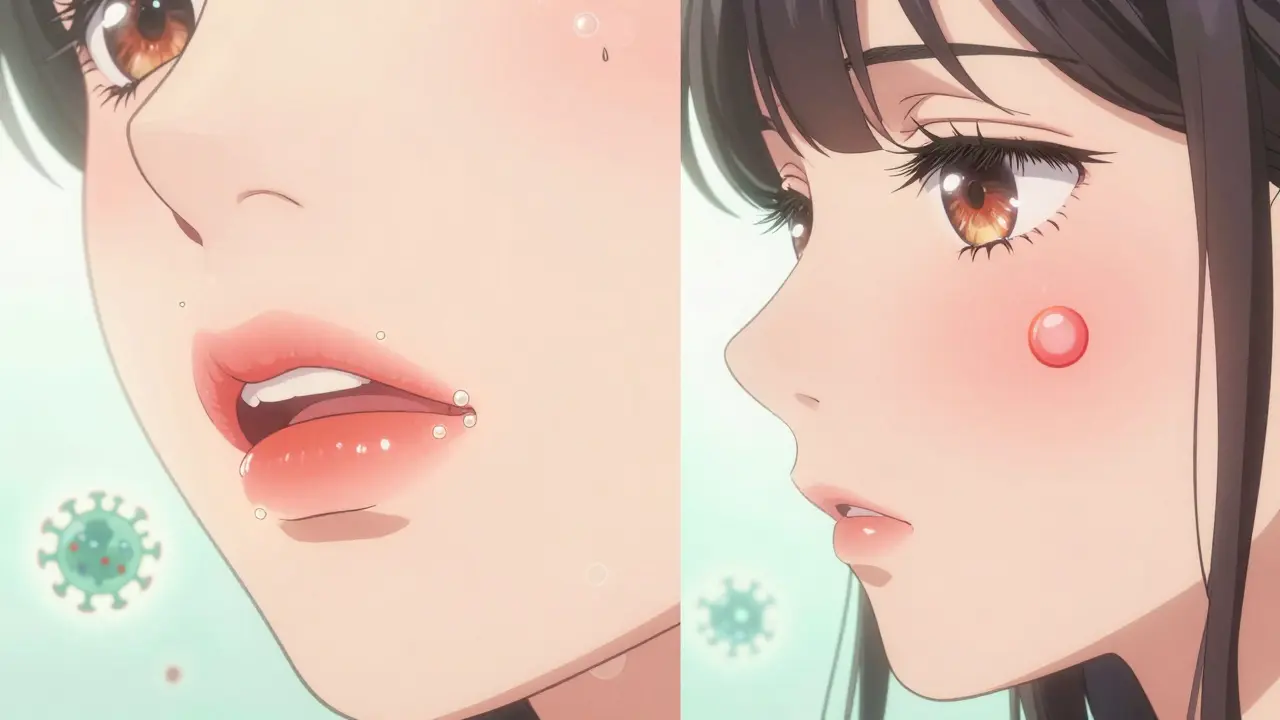
| Appearance | Cluster of small blisters | Single raised bump with pus head |
| Sensation Before | Tingling, burning, itching (12-48 hrs prior) | No warning-just appears |
| Content | Clear fluid turning cloudy | Pus (white/yellow) |
| Contagious? | Yes-HSV-1 virus spreads easily | No-caused by clogged pores |
| Healing Time | 7-14 days without treatment | 3-7 days for minor, weeks for cystic |
Treatment: What Works for Each
Here’s the critical part: cold sores and pimples need completely different treatments. Using the wrong one can make things worse.
If it’s a cold sore, you need antiviral medicine. Prescription options like acyclovir (Zovirax) or valacyclovir (Valtrex) are most effective. Start them the moment you feel that tingling-don’t wait for the blister. Studies show early treatment cuts healing time by 1 to 2 days. Over-the-counter docosanol (Abreva) can help too, but it takes 4 to 5 days to reduce symptoms by half. Prescription penciclovir (Denavir) should be applied every 2 hours while awake for the first 4 days for best results.
If it’s a pimple, use topical acne treatments. Benzoyl peroxide (2.5% to 10%) kills bacteria and reduces inflammation. A 2021 study in the Journal of the American Academy of Dermatology found 2.5% benzoyl peroxide reduced inflammatory acne by 40-60% in four weeks. Salicylic acid (0.5% to 2%) helps unclog pores and prevent new pimples. Apply it once or twice daily. Avoid alcohol-based spot treatments-they dry out and irritate cold sores, making them worse.
Common Mistakes People Make
Most people don’t know the difference until they’ve made a mistake. Here are the top errors:
- Applying toothpaste, baking soda, or rubbing alcohol to a cold sore. These dry out the skin and can rupture blisters, spreading the virus.
- Popping a cold sore like a pimple. This increases healing time by 3 to 5 days and raises the chance of infecting other areas.
- Sharing lip balm, lipstick, or utensils during an outbreak. About 41% of partners catch HSV-1 this way, according to the Journal of Clinical Aesthetic Dermatology.
- Using acne treatments on a cold sore. Dermatologists warn this can cause more blistering and longer outbreaks.
On Reddit’s r/skincareaddiction, 68% of users said they mistook their first cold sore for a pimple. Many of them ended up spreading it to their nose or chin by touching it.
Prevention: Stop Them Before They Start
Since cold sores are viral and lifelong, prevention is key. The University of California San Francisco’s Herpes Research Center found 85% of outbreaks are triggered by:
- UV exposure (32%)
- Stress (28%)
- Hormonal changes (19%)
- Weakened immune system (15%)
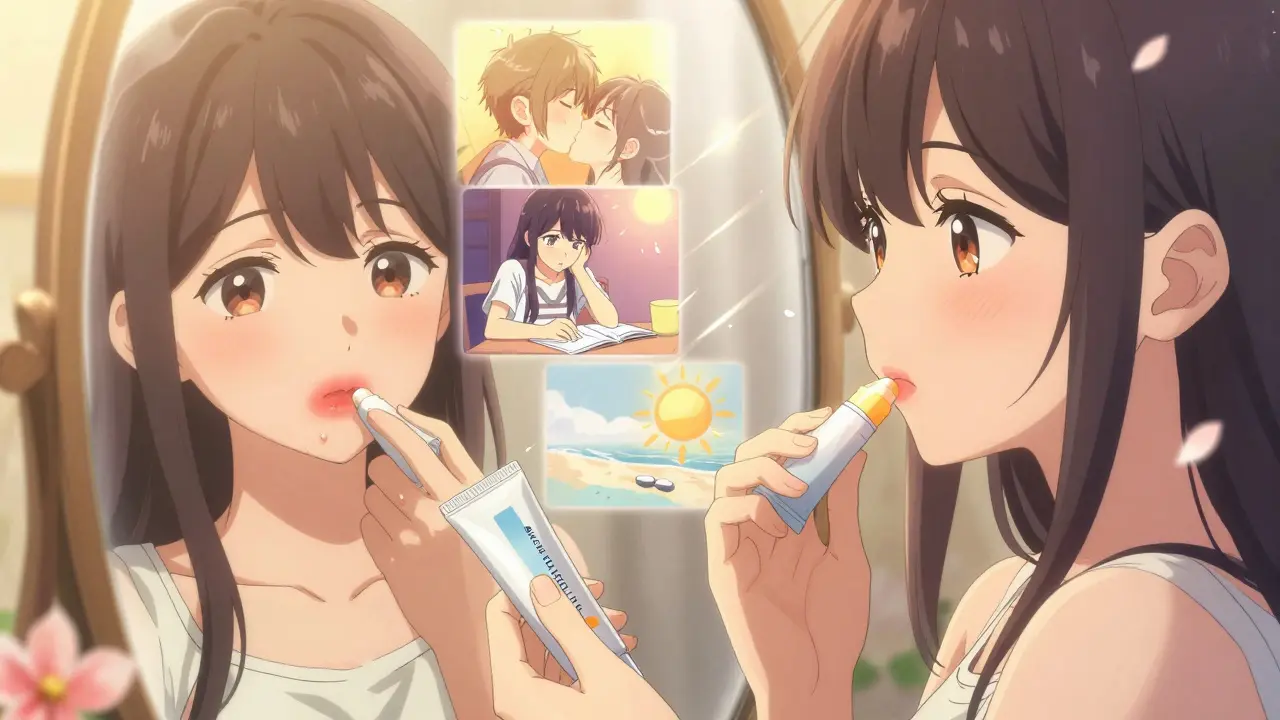
Use sunscreen on your lips daily. Keep stress in check with sleep, exercise, or meditation. Avoid touching your face during outbreaks. Use separate lip balms and applicators. Wash your hands often.
For pimples, stick to a simple routine: cleanse gently twice a day, use non-comedogenic moisturizers, and avoid heavy makeup. Wash pillowcases weekly. Don’t pick at your skin.
When to See a Doctor
You don’t need to see a doctor for every cold sore or pimple. But call a dermatologist if:
- Your cold sore lasts longer than two weeks.
- You get more than five outbreaks a year.
- The sore spreads to your eye, nose, or fingers.
- Your pimple is very large, painful, or leaves scars.
- Over-the-counter acne treatments don’t help after 8 weeks.
There are new treatments on the horizon. In 2023, the FDA approved pritelivir, an experimental antiviral that reduced viral shedding by 70% in trials. For acne, newer products target the skin’s microbiome-killing bad bacteria without wiping out the good ones.
Knowing the difference between a cold sore and a pimple isn’t just about looks. It’s about using the right treatment, avoiding spread, and healing faster. One is a virus you manage. The other is a clog you clear. Get it right, and you’ll save time, pain, and embarrassment.
Can a cold sore turn into a pimple?
No, a cold sore cannot turn into a pimple. They are caused by completely different things: one by a virus (HSV-1), the other by clogged pores and bacteria. But a cold sore can look like a pimple in the early stages, which is why people confuse them. If you think a cold sore is turning into a pimple, you’re likely seeing the scabbing stage-where the blister dries and crusts over. That’s healing, not a new breakout.
Is it safe to pop a cold sore?
Never pop a cold sore. Popping ruptures the blister, which releases infectious fluid and spreads the virus to nearby skin or other people. It also increases inflammation and delays healing by 3 to 5 days. Let it crust naturally. Applying antiviral cream early is the best way to shorten the outbreak.
Can I use benzoyl peroxide on a cold sore?
No, benzoyl peroxide is not safe for cold sores. It’s designed to kill acne-causing bacteria and dry out pimples. On a cold sore, it can burn, irritate, and break open the blisters. This increases the risk of spreading the herpes virus and slows healing. Use antiviral creams instead.
Why do I keep getting cold sores in the same spot?
The herpes virus stays in the same nerve pathway after the first infection. When it reactivates, it travels back down that same nerve to the same spot on your lip. That’s why you often get cold sores in the exact same place-usually the vermillion border. Stress, sun, or illness can trigger it again, but it’s the same virus returning, not a new infection.
Do cold sores mean I have an STD?
Not necessarily. Cold sores are usually caused by herpes simplex virus type 1 (HSV-1), which is most often spread in childhood through non-sexual contact like kissing or sharing cups. HSV-2, which causes genital herpes, is a different strain. While HSV-1 can be spread through oral sex, most cold sores are not related to sexual activity. Having a cold sore doesn’t automatically mean you have an STD.
How long am I contagious with a cold sore?
You’re contagious from the first tingling sensation until the sore is completely healed and the scab has fallen off. The highest risk is when blisters are present and leaking fluid. But the virus can still spread even without visible sores-this is called asymptomatic shedding. To be safe, avoid kissing, sharing lip products, or touching your face during an outbreak and wash your hands often.
Sharon Biggins
January 25, 2026 AT 02:28i used to pop those little bumps like they were zits until i got a nasty outbreak that lasted 3 weeks. never again. now i keep abreva in my bag like it's my emergency key. you guys are right-tingle first, then boom, it's a cold sore. i wish i knew this sooner.
John McGuirk
January 25, 2026 AT 10:43they don't want you to know this but the government put hsv-1 in lip balm to keep people distracted. why else would they push abreva but not cure it? big pharma loves chronic suffering. and don't get me started on sunscreen-sunscreen is a scam. the real trigger is 5g towers.
Michael Camilleri
January 26, 2026 AT 16:56you think you're treating a pimple but really you're inviting the devil into your bloodstream. this isn't just skin deep it's a spiritual test. the body is a temple and you're playing with fire by touching it with dirty fingers. you think you're being smart using benzoyl peroxide but you're just feeding the beast. the virus is waiting. it's always waiting.
lorraine england
January 28, 2026 AT 09:04thank you for this! i had no idea cold sores were contagious before they even looked like anything. i used to kiss my boyfriend when i felt that tingle and now i'm terrified i gave it to him. i started using a separate lip balm and washing my hands like a surgeon. small changes make a big difference.
Darren Links
January 29, 2026 AT 01:48why do americans always act like they invented skin? in britain we just let it run its course. no abreva no valtrex no panic. you think your immune system is weak? maybe you just need less sugar and more tea. also why is everyone so obsessed with popping things? it's a bump not a zit. grow up.
Jamie Hooper
January 29, 2026 AT 09:13my mate said he got a cold sore from sharing a beer can. i told him he was being dramatic. then he got one again next week. now i dont even hand him a napkin. its like herpes is the new covid but nobody talks about it. why? because its embarrassing. we all have it. we just dont say it.
Shelby Marcel
January 30, 2026 AT 00:47wait so if i feel a tingle and i put ice on it does that stop it? or is that just for pimples? i tried it once and it kinda helped but then it still broke out. also does stress really cause it? because i’ve been stressed since 2020
blackbelt security
January 31, 2026 AT 16:46you don’t need fancy creams. you need discipline. wash your hands. cover your mouth when you sneeze. sleep 7 hours. stop touching your face. your body heals faster when you stop being a mess. this isn’t rocket science. it’s basic human hygiene.
Patrick Gornik
February 1, 2026 AT 10:35the real tragedy here isn't the virus-it's the capitalist commodification of suffering. we’ve turned a natural immune response into a $2 billion industry of topical snake oil. docosanol? pfft. the body doesn’t need chemicals to heal-it needs alignment. the herpes simplex virus is just a messenger. it’s telling you you’re disconnected from your breath, from your earth, from your sacred rhythm. stop treating symptoms. start treating your soul. and yes i’ve had 17 cold sores in 5 years. i’m still here. still breathing. still evolving.